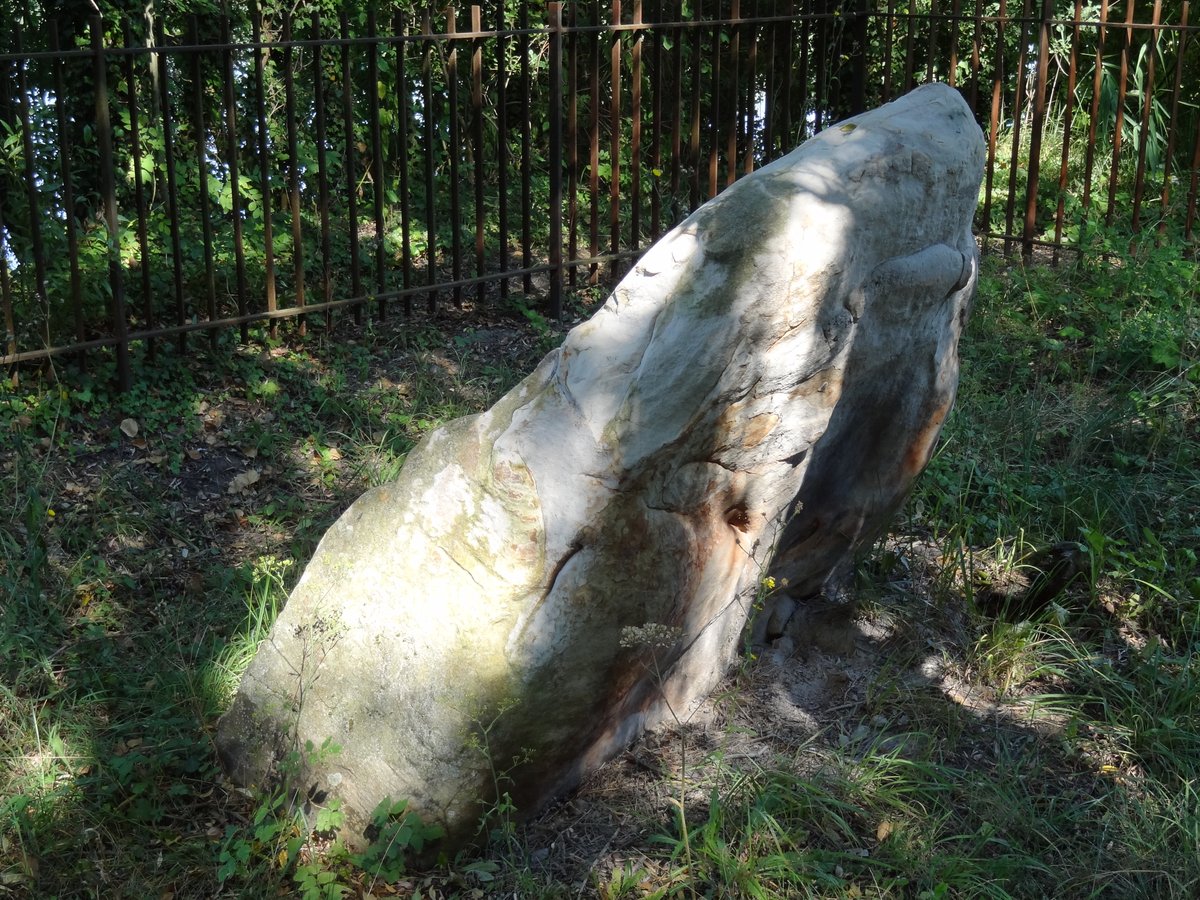

The Beaumirault stone, located in Bruyères-le-Châtel, France, is a menhir dating from the Neolithic era. It is a block of Fontainebleau sandstone, roughly triangular in shape, which is strongly inclined from an unknown but ancient date. The stone is 2 metres wide at the base and is thought to be buried at least 1.5 metres deep into the ground.
In 1619, the stone was mentioned on maps under the name pierre du Beau Miroir, which was later deformed into Beaumirault or Mirou. It was officially listed as a historical monument on September 7, 1978. The site is owned by the commune and is situated in a wooded area on a small artificial peninsula created by the digging of a reservoir.
The stone is associated with the legend of Gargantua. According to one version, the menhir was a stone slipped into his shoe that he discarded at this location. In another version, the stone is said to be a petrified piece of waste from the giant. The site has been documented in works by John Peek (1975) and Alain Bénard (2012).
Sources: Wikipedia, OpenStreetMap, Wikidata, Wikimedia Commons

Written by Nicolo Ciampini
Discuss this with the author and others
No comments yet. Be the first to start the conversation.