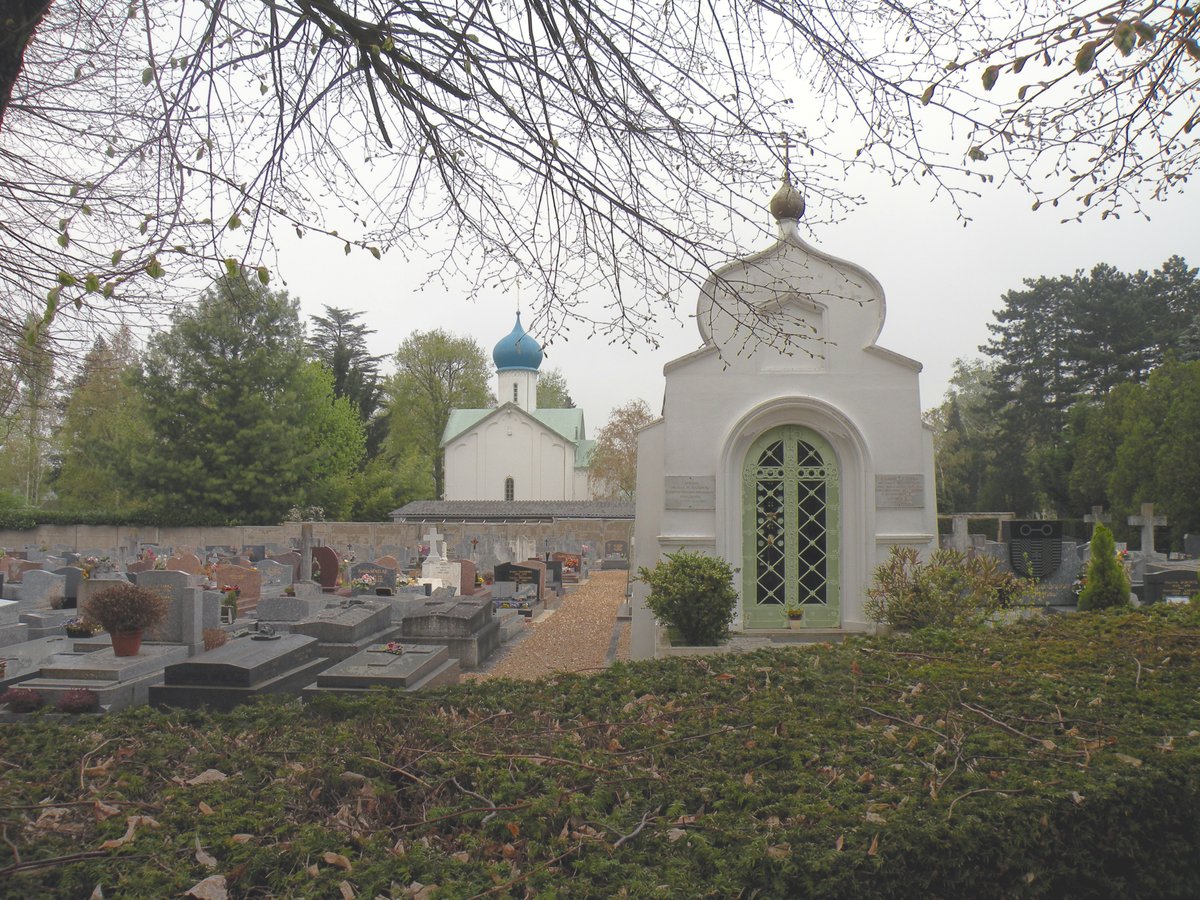

In 1927, some land was granted in the town of Sainte-Geneviève-des-Bois to an English benefactress named Dorothy Paget. Working with Elena Orlov and Princess Vera Meshchersky, who operated a retirement home for Russian émigrés nearby, Paget provided a space for the burials of the White Russians who arrived in Paris after the Bolshevik revolution. This area became known as the Russian Cemetery, a part of the larger Cimetière de Liers, located 25 km south of Paris.
To serve the cemetery, the Dormition Church was designed by Albert Benois between 1938 and 1939. The building is regarded as an important historic monument, designed in the style of 15th and 16th-century Novgorod Churches. To create an authentic Russian feel, many trees have been planted throughout the grounds. The cemetery contains one mausoleum and is estimated to house more than 5,000 graves.
The site contains the remains of an estimated 10,000 to 15,000 Russian emigrants and French people of Russian origin. Notable burials include the Nobel Prize winner Ivan Bunin and the dancer Rudolf Nureyev. Nureyev's tomb is decorated with a mosaic representing a traditional kilim blanket. The grounds also hold the graves of various poets, generals, aristocrats, and scientists.
While the French Ministry of Culture recognizes the cemetery as an important historical monument and it has an entry in the Base Mérimée, it lacks official landmark status. Since the 1960s, municipal authorities have periodically attempted to close the cemetery for public services, and some surrounding areas have been developed into housing estates. Because its future remains precarious, several notable figures, including Ivan Ilyin and Ivan Shmelev, were exhumed and reburied in Moscow. The cemetery is currently closed to new burials.
Sources: Wikipedia, Wikidata, Wikimedia Commons
Written by Nicolo Ciampini
Discuss this with the author and others
No comments yet. Be the first to start the conversation.