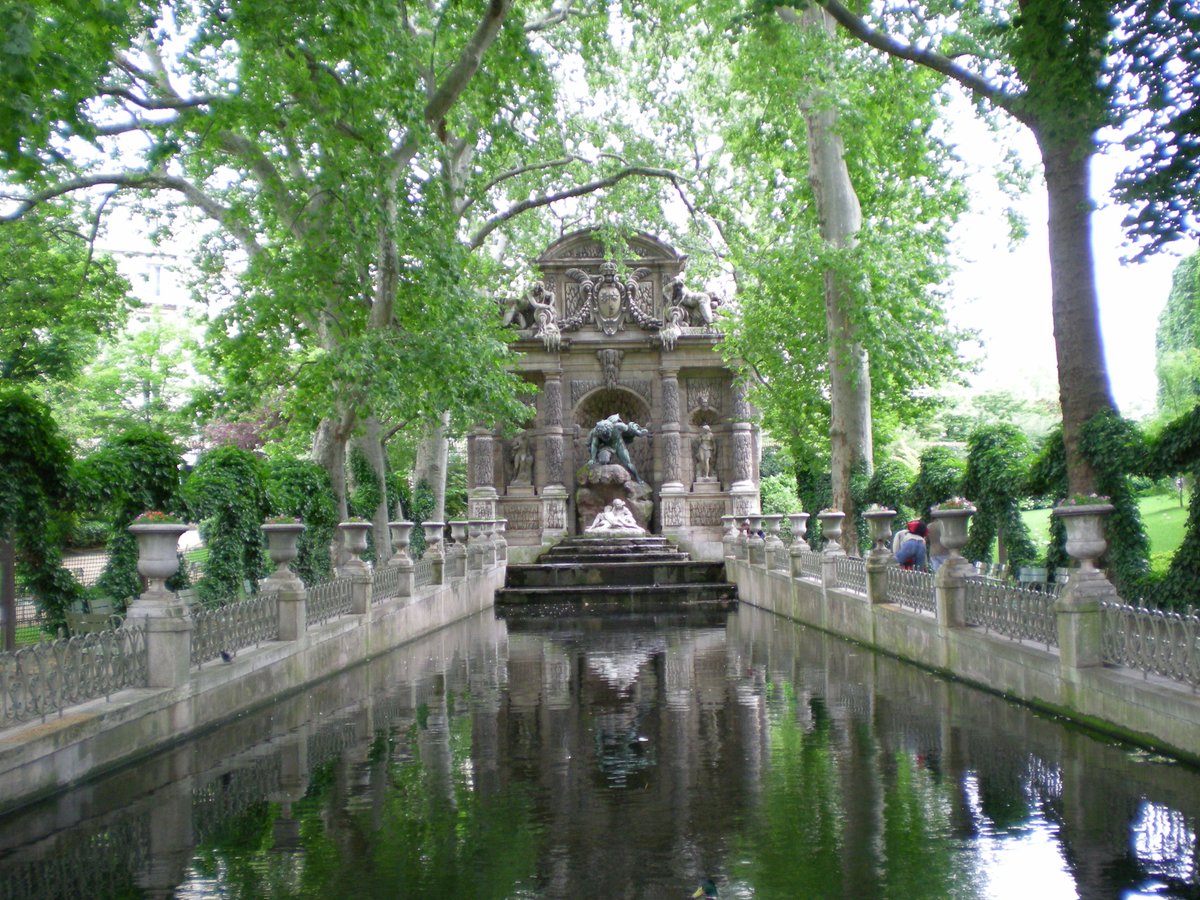

The Medici Fountain is a monumental fountain in the Jardin du Luxembourg in the 6th arrondissement in Paris. Built around 1630, it was commissioned by Marie de' Medici, the widow of King Henri IV and regent of King Louis XIII. The fountain and grotto was most probably the work of Tommaso Francini, a technician who had worked on fountains in the new gardens of the Medici villas in Florence and Rome. The fountain faced major challenges during the 17th century due to the chronic water scarcity on Paris's Left Bank.
Despite this, the Medici Fountain was eventually completed and remains in operation to this day. Its grotto facade, reminiscent of Italian Renaissance grottos, is adorned with reliefs that mimic water seeping from rocky walls. During its rebuilding in 1864-1866, the statue of Venus was replaced with a group of statues by Auguste Ottin, representing the giant Polyphemus in bronze discovering the lovers Acis and Galatea in white marble.
It shares the space with the Fontaine de Léda, which was constructed in 1806-1809 and was relocated to the Jardin du Luxembourg in 1858. Because it was a wall fountain, it was placed on the back of the Medici Fountain, where it still remains today.
Sources: Wikipedia, OpenStreetMap, Wikidata, Wikimedia Commons






Written by Nicolo Ciampini
Discuss this with the author and others
No comments yet. Be the first to start the conversation.