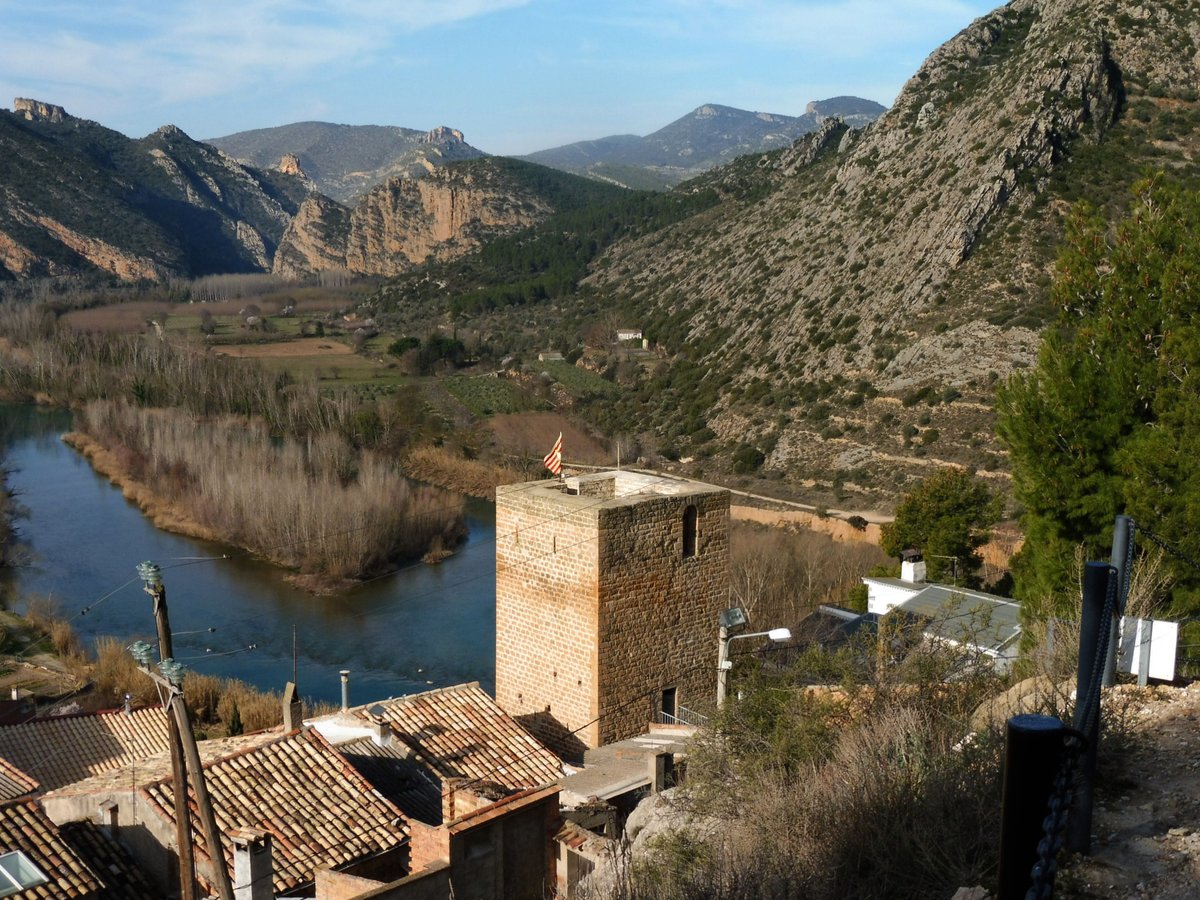

Standing tall on a hilltop in Camarasa, Spain, the Castell de Camarasa is a Hisn Andalusi castle, strategically located to dominate the passage of the Segre River towards the Llorenç plains and control the road to Cubells. The name Camarasa could come from the term 'kum ruasia' or residence of chiefs (note). The castle is a cultural site of national interest declared by the Spanish government, dating back to the 11th century. It was ceded to Count Ramon Berenguer I of Barcelona in 1050, who then granted it to Arnau Mir de Tost. In 1056, the castells of Camarasa and Cubells were assigned to Count Ramon Berenguer I’s wife Almodis de la Marca as part of their wedding gifts.
A rectangular tower was built 30 meters west of Sant Miquel’s church, with dimensions of 7.80m X 6.20m and a height of 3-4m on the north side and 7m on the south side. The construction has limestone blocks, small and well squared, with irregular masonry enclosed with lime mortar. However, it is unclear if it was part of the fortified enclosure or an outwork (note).
A square-shaped ganluffy (albarrana) located at the west end of the castle street, oriented north-south, was also built around the same period. The ganluffy has a size of 6m X 5.80m, a height of 12m, and a wall thickness of 1.50m. It still has three levels. The first floor has a pointed arch-headed door on the north side, an opening on the south side, and three full and one sectioned arrowslits. The second floor has an opening on the north side with a pointed arch, two full and one sectioned arrowslits.
Sources: Wikipedia, OpenStreetMap, Wikidata, Wikimedia Commons
Written by Nik Frost
Discuss this with the author and others
No comments yet. Be the first to start the conversation.