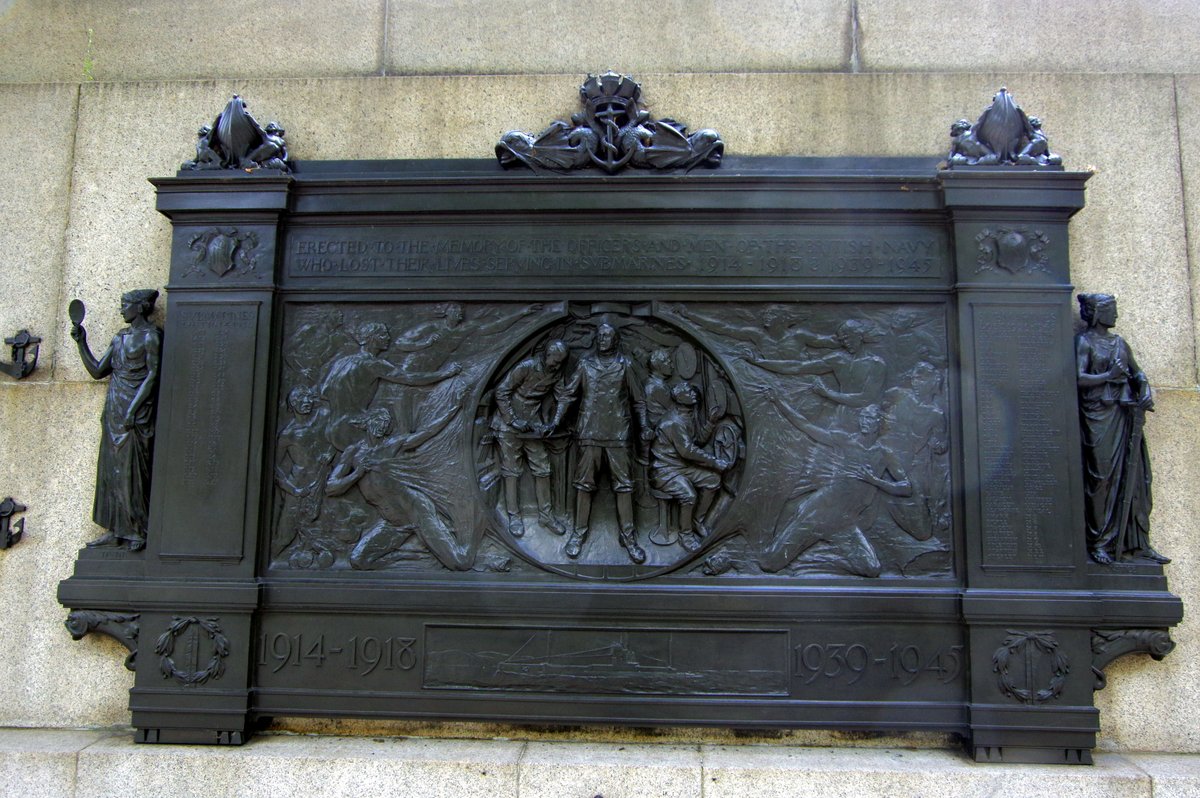
The National Submariners' War Memorial stands on the Victoria Embankment in London, a city in the United Kingdom. It commemorates the Royal Navy submariners who died in the First and Second World Wars. Unlike popular belief, this memorial was not funded by public subscription but by a royal disposition due to it being a war memorial. The memorial is a Grade II* listed building, and is the focal point of a special memorial walk and laying of wreaths held each year by the submariners on the Sunday preceding Remembrance Sunday. The memorial was designed by the architect Arthur Heron Ryan Tenison, and bears a bronze sculpture by Frederick Brook Hitch which was cast by the Parlanti Foundry.
The memorial is built into a granite pier that was once part of the entrance to Temple Pier, a boat landing stage on the Victoria Embankment. The memorial stands on granite steps, supporting a large bronze bas relief within an architectural frame. The bas relief shows the interior of a submarine and another with nereids swimming on either side. On either side of the central bronze plaques are 40 bronze wreath hooks in the form of anchors. At the top of the memorial is the inscription ‘Erected to the memory of the officers and men of the British Navy who lost their lives serving in submarines 1914–1918 and 1939–1945’.
The original memorial was unveiled on 15 December 1922 by Rear Admiral Sir Hugh Sinclair, and dedicated by the Chaplain of the Fleet, Archdeacon Charles Ingles. Further panels commemorating the Second World War were unveiled on 15 November 1959. An additional plaque was added in 1992 to commemorate the 70th anniversary of the unveiling of the original memorial.
Sources: Wikipedia, OpenStreetMap, Wikidata, Wikimedia Commons
Written by Nicolo Ciampini
Discuss this with the author and others
No comments yet. Be the first to start the conversation.