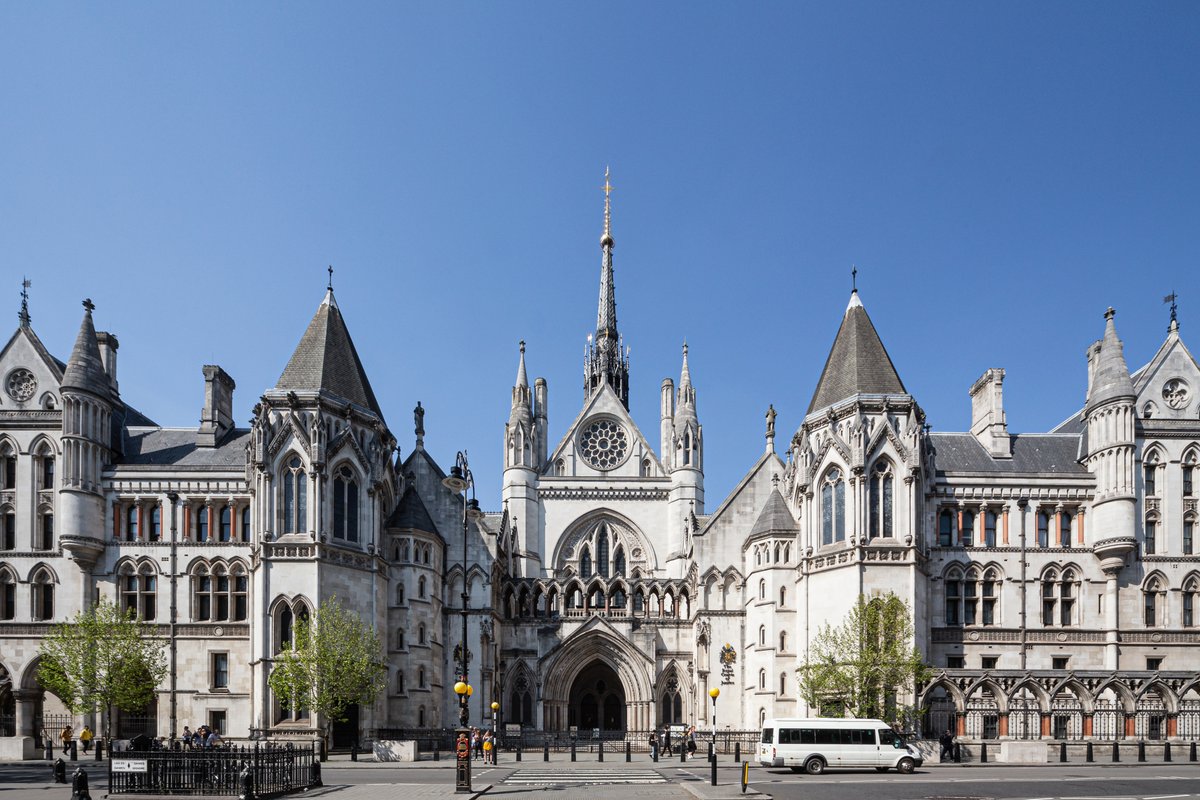

The Royal Courts of Justice, commonly called the Law Courts, is a massive grey stone edifice in the Victorian Gothic Revival style. It was built to replace the old Westminster Hall, which had become too small for the growing needs of the law. To create the six-acre site, the government demolished 450 houses in the area around the Strand.
George Edmund Street won the design competition for the building. Construction began in 1873 by Messrs Bull & Sons of Southampton. At an early stage, the masons led a serious strike that threatened to spread to other trades, causing a temporary stoppage of the works. In response, foreign workmen - mostly Germans - were brought in. This caused bitter hostility from the striking men, and the newcomers had to be housed and fed within the building itself. The building took eight years to complete, and Street died before it was officially opened by Queen Victoria in 1882.
Internally, the courts are arranged off the Great Hall, which contains a bust of Queen Victoria by Alfred Gilbert. The building features statues of Moses, Solomon, and Alfred the Great, which symbolise the pillars of English legal tradition. While one historian described it as a regular mongrel affair, another called it the last great secular building of the Gothic Revival.
Today, the building continues to serve as a major courthouse. It was used as a Nightingale Court for criminal trials during the COVID-19 pandemic in 2021. On 8 September 2025, a mural by Banksy was discovered on the building, depicting a judge using a gavel to beat a protester. The mural was covered up and guarded by security staff before being removed.
Sources: Wikipedia, OpenStreetMap, Wikidata, Wikimedia Commons

Written by Nicolo Ciampini
Discuss this with the author and others
No comments yet. Be the first to start the conversation.