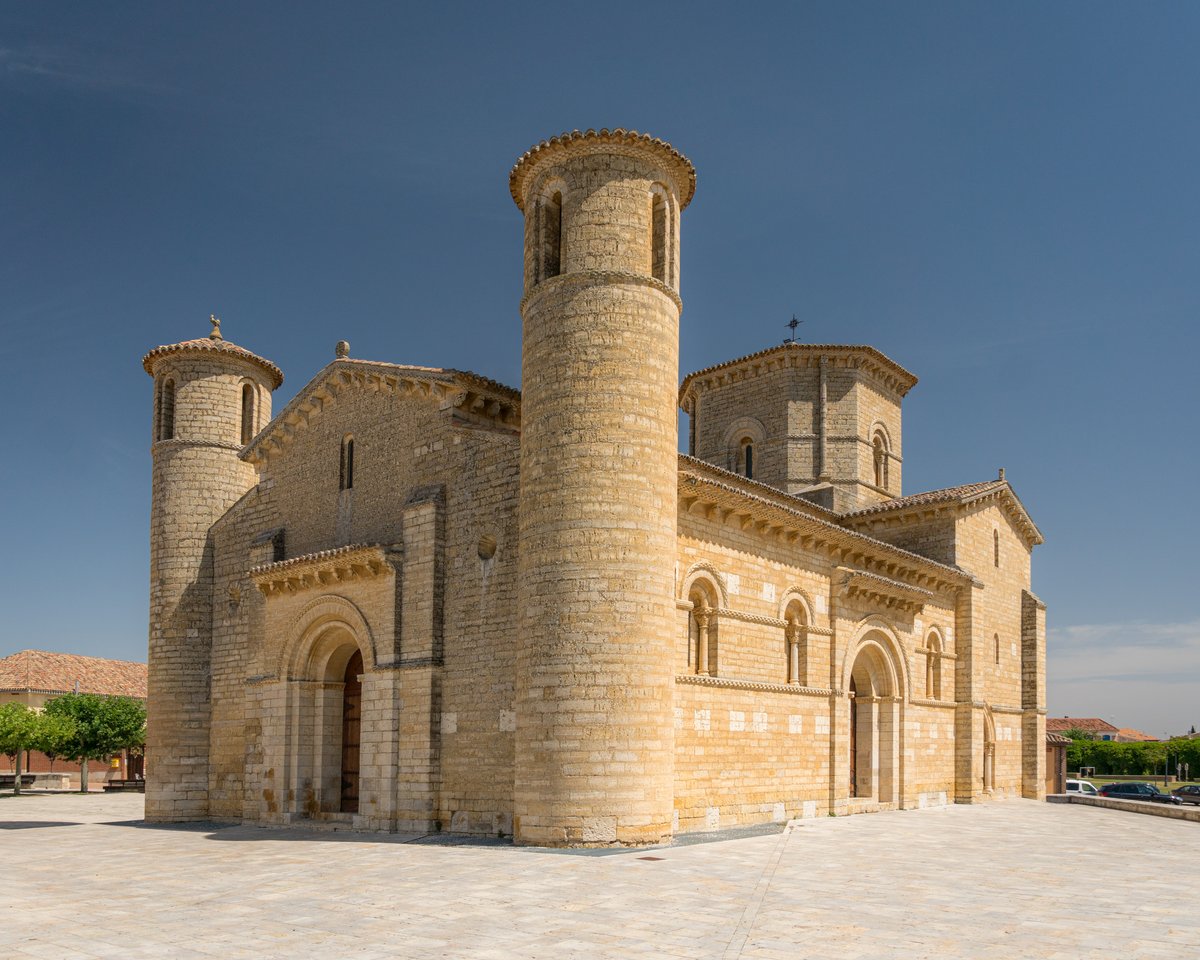

Located in the province of Palencia, Spain, the Church of Saint Martin of Tours was built in the 11th century in the Romanesque style. The construction began in the second half of the 11th century by the will of Queen Muniadona of Castile as part of a monastery. The church is mentioned for the first time in 1066 and is stylistically connected to other Romanesque edifices on the Way of St. James, such as Jaca Cathedral or San Isidoro de León.
In 1118, the church was assigned to the Benedictine priory of San Zoilo at Carrión de los Condes. After the monks abandoned the site in the 13th century, the church underwent several changes in ownership. During the 15th century, it received a new bell tower over the original dome and a sacristy. Although it fell into decay after the Middle Ages and was declared unfit for use in the 19th century, it was declared a National Monument in 1894. A restoration followed that returned the building to its original state, and it was reopened to the public in 1904.
The church features a typical Romanesque exterior with a three-level façade and two cylindrical bell towers. Its interior follows a pseudobasilica plan with barrel vaults and an octagonal dome at the crossing. One of its most remarkable features is the sculpture by the Maestro de la Orestíada, also known as the Maestro de Jaca-Frómista. His work was inspired by a Roman sepulchre and recovers the naturalism and perfection of the human body typical of classical Greco-Roman sculpture.
Sources: Wikipedia, OpenStreetMap, Wikidata, Wikimedia Commons
Written by Nik Frost
Discuss this with the author and others
No comments yet. Be the first to start the conversation.