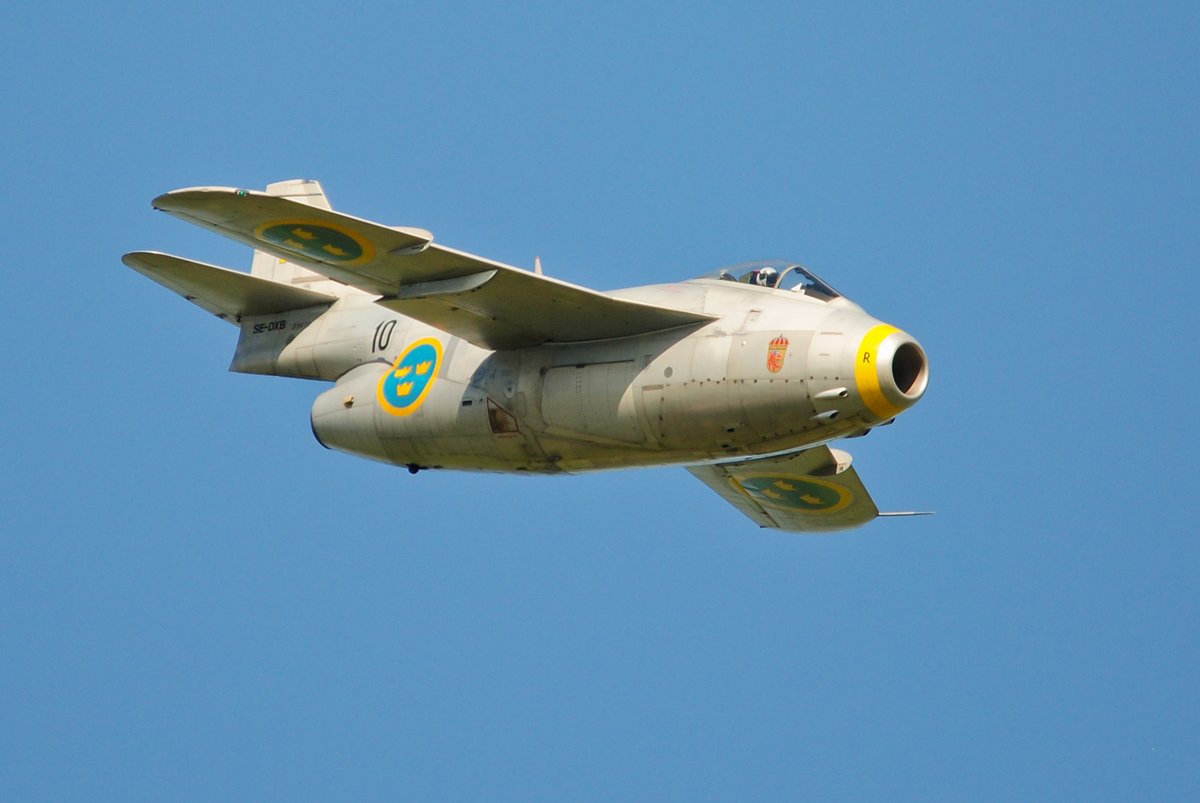

The Saab 29 Tunnan, more commonly known as ‘The Flying Barrel’, was Sweden's first aircraft designed for jet propulsion. Project 'JxR' was initiated in late 1945, leading to the requirements being drawn up in October. Two design proposals, R 101 and R 1001, were presented. R 1001, chosen following its selection, was given the nickname ‘the barrel’ early on. This unique design featured the undercarriage retracting into the fuselage.
German aerodynamic research during the wartime aided in the design, with the de Havilland Ghost turbojet engine powering the Tunnan. The Swedish Air Force requested verification of its performance and a production plan in February 1946. The first flight by a Saab 29 prototype took place on 1 September 1948, after which it was nicknamed ‘Flygande Tunnan’ or ‘The Flying Barrel’.
As the second turbojet-powered combat aircraft produced in Sweden, the Tunnan featured a single round air intake in the nose and a moderately swept wing. It was relatively fast and agile, with Sweden's Air Force operating it in both fighter and fighter-bomber roles into the 1970s. The Tunnan saw combat in the Republic of Congo as Sweden's contribution to a UN peacekeeping mission.
Sources: Wikipedia, OpenStreetMap, Wikidata, Wikimedia Commons
Written by Nik Frost
Discuss this with the author and others
No comments yet. Be the first to start the conversation.