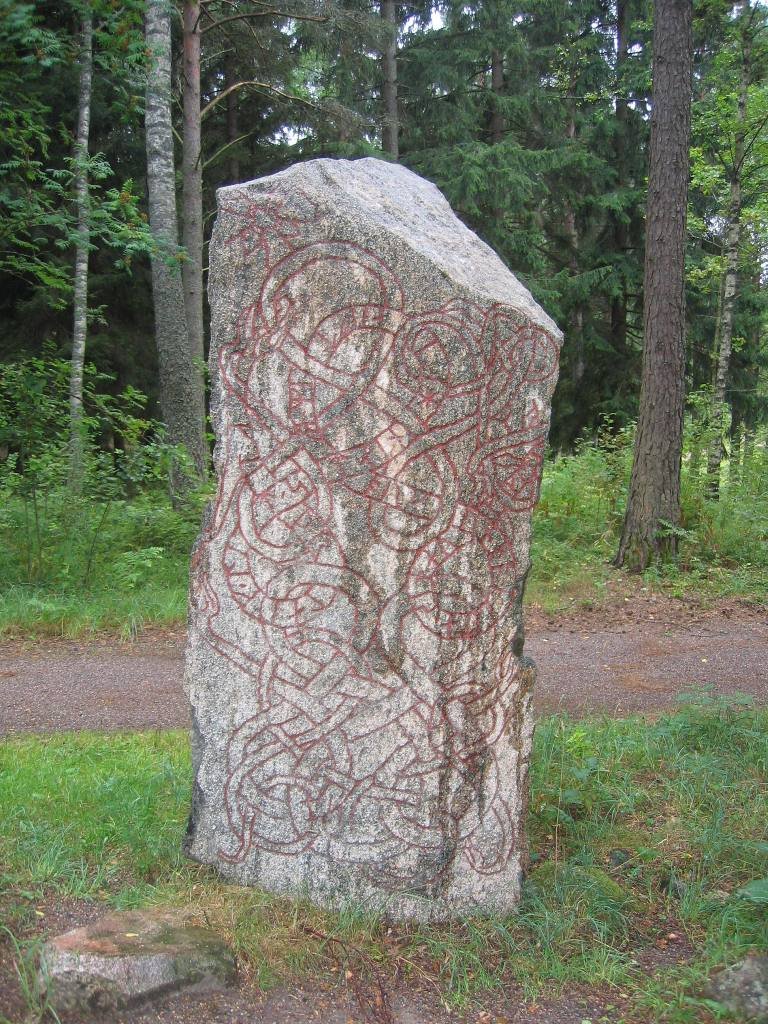

Smedby's rune stone, known as Upplands runic inscription 294, is a curious relic of ancient Uppland. It stands on its original site by the road between Smedby and Vilunda, where it has been since it was erected in the tenth century. The stone is one of three along the Fornstigen, an ancient path that connected homes in Smedby and Villunda. The inscription tells the story of Gudlög, a woman who erected the stone in memory of her husband, Forkunn, and another man named Kättilälv.
The inscription is written in the younger futhark, a script used between the eighth and twelfth centuries. It is striking for its simplicity, consisting of just six pairs of runes. "Gudlög let hugga stenen efter Forkunn, sin make and Kättilälv (lät också hugga)". The translation, familiar to scholars of runic inscriptions, reads: 'Gudlög let inscribe the stone in memory of Forkunn, her husband, and also Kättilälv'.
But who was this Kättilälv, as unknown today as he was in his own time? How did he come to be commemorated alongside Forkunn? And what was the connection between these three stones, the Vilundastenarna, that stand along the Fornstigen? These questions may never be answered, but Smedby's rune stone remains a testament to the lives of the people who lived here centuries ago, and a tantalizing glimpse into the mysteries of the past.
Sources: Wikipedia, OpenStreetMap, Wikidata, Wikimedia Commons
Written by Nik Frost
Discuss this with the author and others
No comments yet. Be the first to start the conversation.