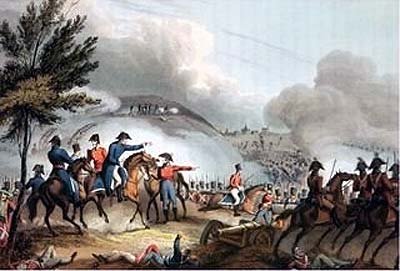

The Battle of Salamanca, fought as part of the Peninsular War on 22 July 1812, south of Salamanca, Spain, was a landmark victory for the Anglo-Portuguese coalition under the command of the Duke of Wellington. This significant victory marked a turning point in the conflict against Napoleon's French Empire, weakening its grip on Spain. The Anglo-Portuguese coalition, bolstered by the victory, marched into Madrid shortly after, symbolizing the liberation of Spain from French control.
The losses for the French at Salamanca were heavy, with estimates suggesting between 12,000 and 17,000 killed, wounded, or captured, compared to approximately 4,800 casualties for the Allied forces. The French commander, Marshal Auguste Marmont, made several strategic errors that contributed to this defeat. The Anglo-Portuguese forces capitalized on these errors with a series of flanking maneuvers, leading to a rout of the French left wing, and ultimately, a decisive victory.
Sources: Wikipedia, OpenStreetMap, Wikidata, Wikimedia Commons
Written by Nik Frost
Discuss this with the author and others
No comments yet. Be the first to start the conversation.