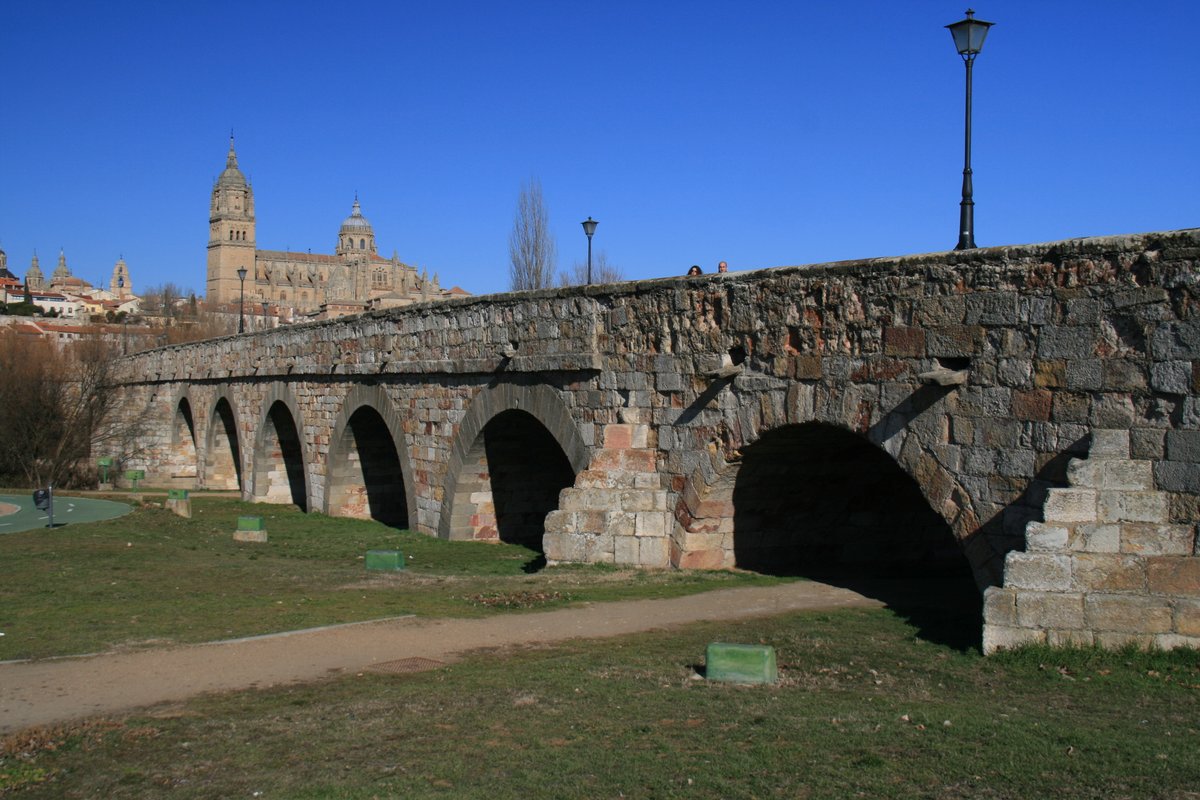

The Roman bridge of Salamanca, also known as Puente Mayor del Tormes and as Puente Prinçipal, is a Roman bridge crossing the Tormes River in the city of Salamanca, Castile and León, Spain. The bridge, which dates to the period of Roman occupation of the Iberian Peninsula (between 27 BCE and 79 CE), provided access to the southern part of the city and is part of the historic road known as the Vía de la Plata, passing between Mérida and Astorga. The bridge is associated with legends that Claim Hercules built it, and Trajan and Hadrian rebuilt it.
The bridge has been rebuilt a number of times since its original construction, with the section on the right bank to the city of Salamanca retaining the majority of the original Roman construction. One of the most significant moments in the bridge's history is the Battle of Salamanca in 1812. Part of the Peninsular War, the battle was fought between British and Portuguese forces and the Napoleonic French. The Roman bridge of Salamanca was captured by the Duke of Wellington the day before the battle and was a strategic target during the conflict.
It was a turning point in the Peninsular War. In contemporary times, modern vehicular bridges have replaced the Roman bridge of Salamanca for commerce.
Little information is available on its history before the 13th century, when the pre-Roman Vettones sculpture, known as the Verroco del Puente, began to be associated with the bridge. The Verroco del Puente is a stone sculpture of a bull, which dates to the pre-Roman Vettones people. The bridge is part of the city's coat of arms, a testament to its historical significance. On 3 June 1931, the bridge was named an Artistic Historic Monument, and Bien de Interés Cultural in 1998.
Sources: Wikipedia, OpenStreetMap, Wikidata, Wikimedia Commons
Written by Nik Frost
Discuss this with the author and others
No comments yet. Be the first to start the conversation.