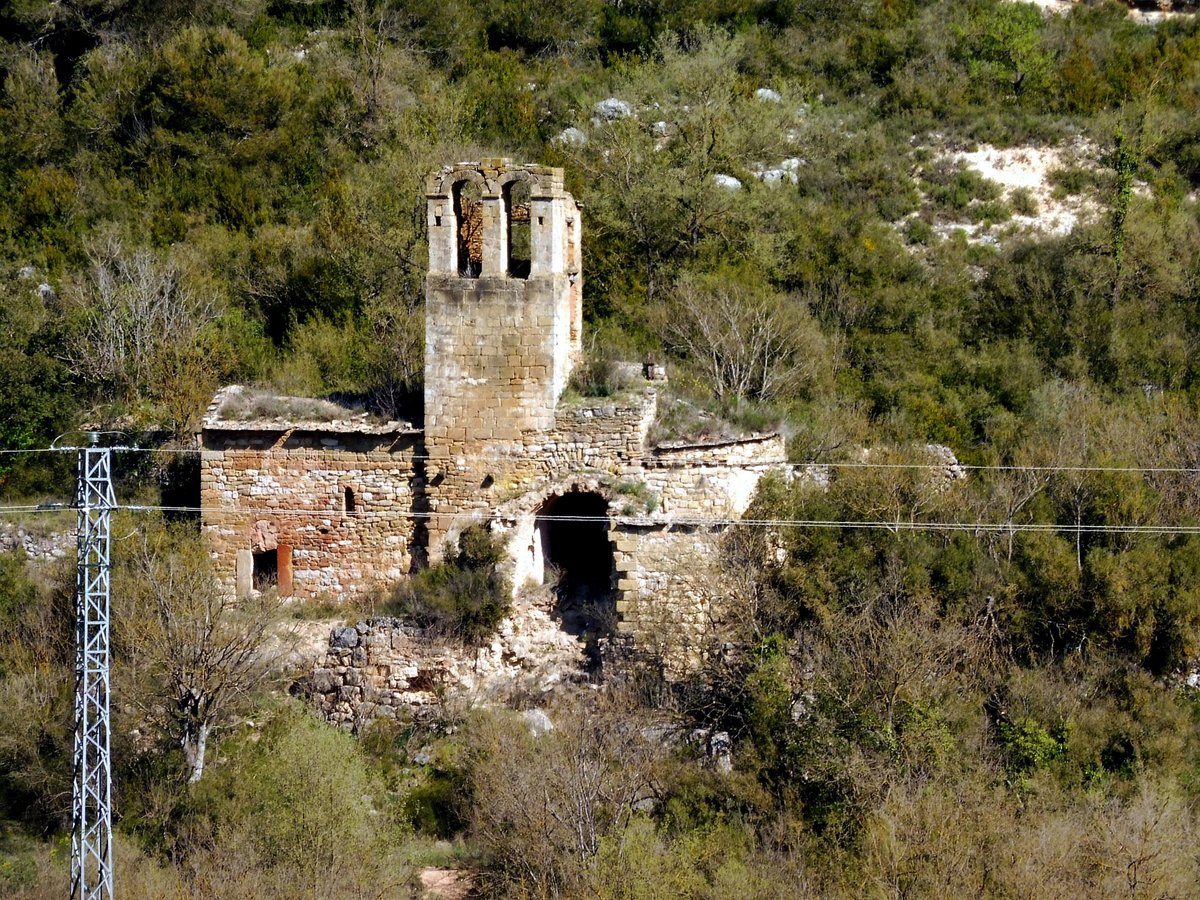

In the hills of Vilanova de Meià, Spain, Mare de Déu del Remei d'Argentera stands as a relic of a bygone era. Originally built in the 12th century, it served as the parish church for the town until the 19th century, when it was abandoned due to religious reform. Sitting atop a hill, the church was dependent on the Priory of Meià until the 19th century desamortization. **According to records dating back to 1068, the preacher Eldomar granted his estate executors permission to distribute his goods, which included half a vineyard and half a mill located in Argentera.**
The church was first mentioned in a capbreu in 1137, among the properties of the monastery of Santa Maria de Meià. The exact timeline of the church's donation to the monastery remains uncertain. The church's functions and the old advocacy **were confirmed in 1315 by the visit of the Archbishop of Tarragona, who inspected the temple and the parish.** The church had a sufragany church in the nearby place of Gàrzola. The church was renovated in the 17th century, and its name was changed to Nuestra Señora de Argentera. **It is also cited as Nuestra Señora del Rosario near the Castle of Argentera.**
The church is covered with a barrel vault with pointed arches. The oldest part of the preserved construction **is the western sector, probably from the end of the 11th or early 12th century, but far from Lombard forms.** The apse and the entire eastern sector were replaced and expanded by the current one, probably dated to the 13th century, which was closer to Gothic and was later modified with the two chapels. Today, the church stands in disrepair, its rough western sector hidden behind a wooden window, a reminder of its history. Mare de Déu del Remei d'Argentera is located in the Municipality of Vilanova de Meià, Province of Lérida, Spain.
Sources: Wikipedia, OpenStreetMap, Wikidata, Wikimedia Commons
Written by Nik Frost
Discuss this with the author and others
No comments yet. Be the first to start the conversation.