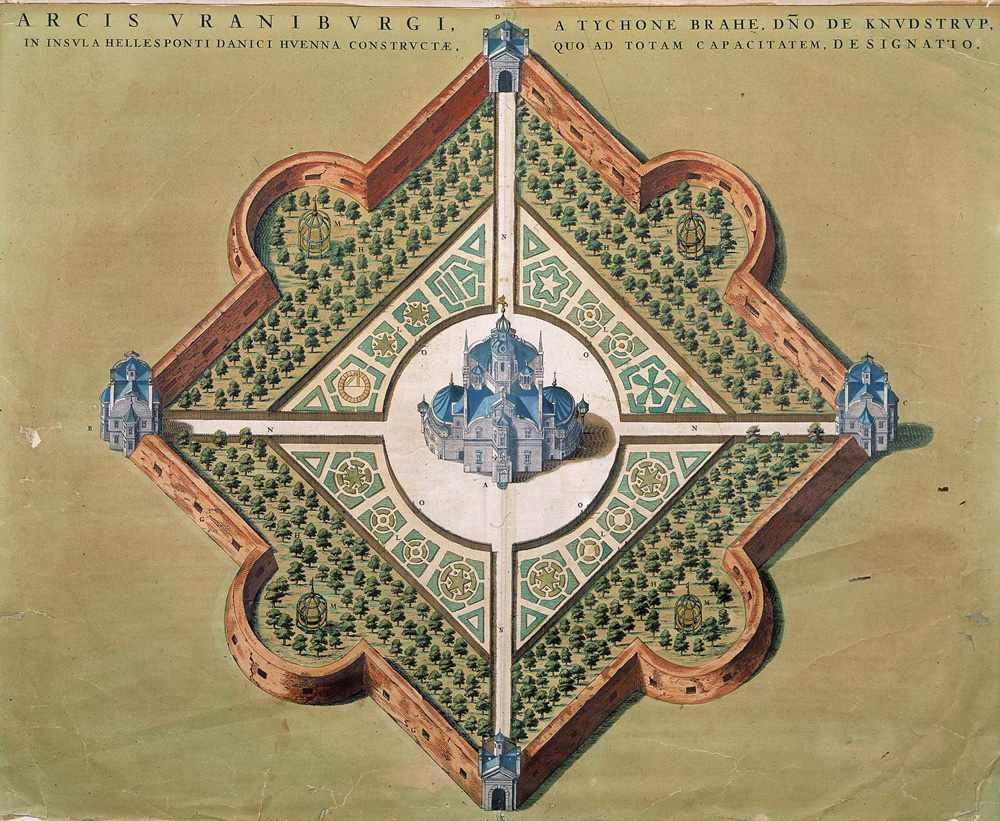

The castle built for the stars was established and operated by the Danish astronomer Tycho Brahe under the patronage of King Frederick II of Denmark. It was the first custom-built observatory in modern Europe, and the last to be built without a telescope as its primary instrument. Tycho carefully specified the proportions of Uraniborg, which was built on grids in the Flemish Renaissance style from 1576 to 1580.
Uraniborg was dedicated to Urania, the Muse of Astronomy, and it took Tycho seven years to assemble and equip the observatory. The main building was square, approximately 15 meters on each side, with two semi-circular towers on the north and south sides. The plan and façade of Uraniborg were designed on a grid, with the proportions intended to function as an astrological talisman, benefiting the health of its occupants by increasing the influences of the Sun and Jupiter.
On the main floor, Tycho Brahe and his family had one room, while visiting astronomers occupied three others. The northern tower housed the kitchens, and the southern tower housed a library. The library and personal study of Tycho featured the etched motto 'Non haberi sed esse'.
James VI of Scotland (later James I of England) visited Uraniborg on March 20, 1590. On the second floor, the larger room was reserved for visiting royalty, while the primary astronomical instruments were housed here. Balconies housed additional instruments, slightly further from the building, giving them a wider angle of view.
The third floor was subdivided into eight smaller rooms for students. A large basement housed an alchemical laboratory and storage for food, salt, and fuel. Uraniborg contained a large mural quadrant. A large wall was planned for Uraniborg, but never built. Instead, a high earth mound was constructed instead, which still stands today.
Uraniborg was eventually abandoned by Tycho Brahe in 1597 after he fell out of favour with the Danish king, Christian IV of Denmark. Uraniborg's institution was destroyed in 1601 after Tycho's death. Ven, where Uraniborg stood, was later lost to Sweden. The Rundetårn (Round Tower) in Copenhagen was inaugurated in 1642 as a replacement.
Sources: Wikipedia, OpenStreetMap, Wikidata, Wikimedia Commons
Written by Nik Frost
Discuss this with the author and others
No comments yet. Be the first to start the conversation.