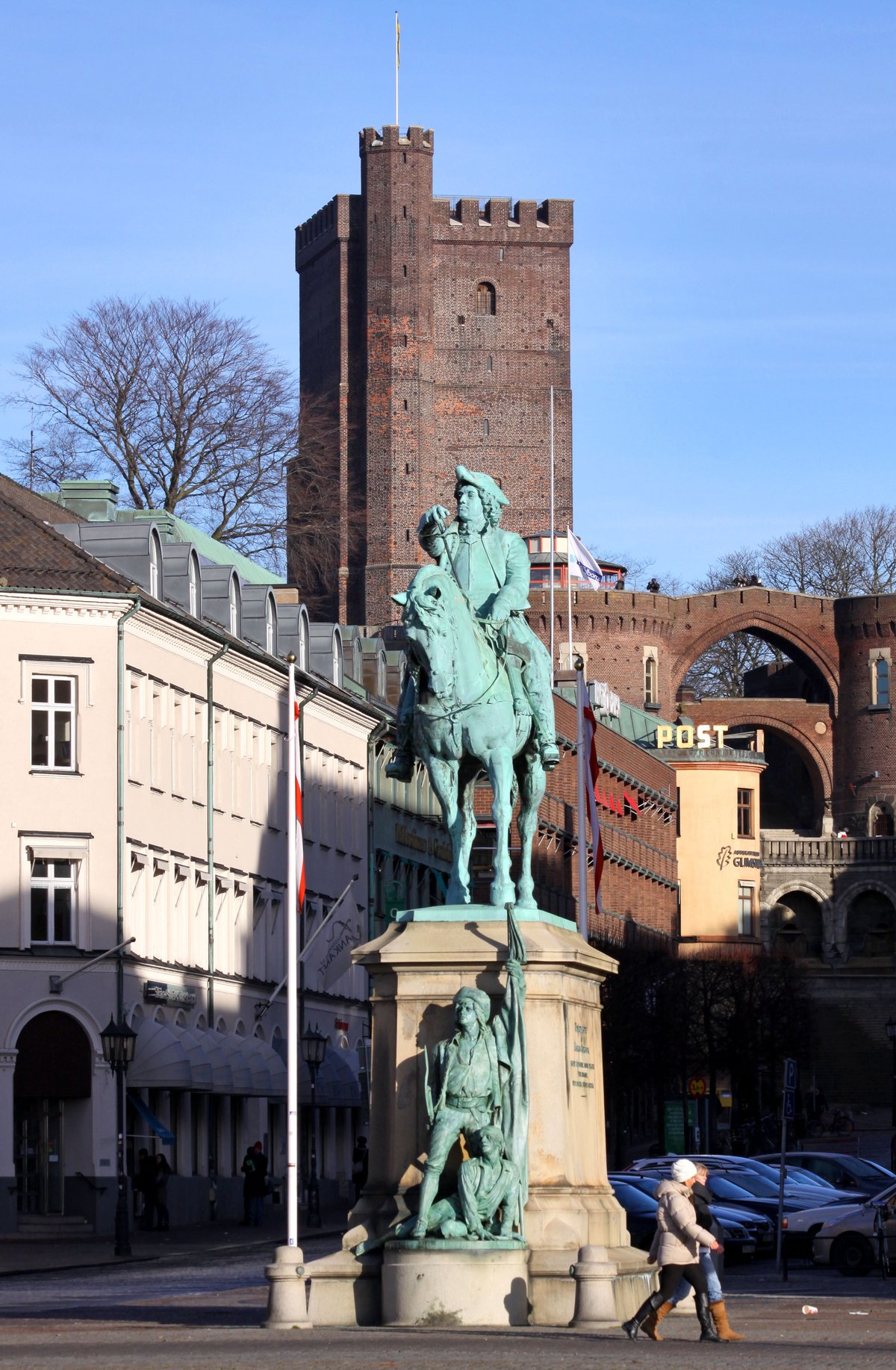

In the early 1800s, plans were made in Helsingborg to commemorate the Swedish victory over Denmark in the Battle of Helsingborg, fought on March 10, 1710. But the collection of funds for the statue went poorly, despite the patriotic spirit behind it. Four decades later, things had changed. In 1898, the collection of the statue was announced with a competition for the best sculpture design. Four modeling proposals were submitted for the statue, made of lime or gypsum.
John Börjeson won first place with the pseudonym 'TOM', while 'Flink och färdig' (Carl Hammar) came in second. The contract for the statue's production was signed with Börjeson in 1899. The total cost of the statue and pedestal, including casting, was just over 90,000 kronor, which would be nearly 4 million kronor in today’s currency. The statue was cast in Stockholm by the foundries Otto Meyer and Aktiebolaget Förenade Konstgjuteriet and was transported to Helsingborg by train in October 1901.
On December 3, 1901, the statue was unveiled and consecrated. The event was attended by 11,000 students, local authorities, and even the former landshövding Gotthard Wachtmeister and members of the Länsstyrelsen. The statue was moved 20 meters east and 1.2 meters lower in 1959 to avoid traffic problems. Today, the Magnus Stenbock statue stands 4.3 meters high, 1.5 meters wide, and 3.5 meters long and weighs 4 tons. The statue is of Magnus Stenbock after the Battle of Helsingborg with his sword down in a sheath.
The horse in the statue is designed to travel and has two rifle pistols in holsters on each side. The original plan for the statue was to have the sword pointed towards Denmark, but this was not implemented due to it being considered a provocative gesture.
Sources: Wikipedia, OpenStreetMap, Wikidata, Wikimedia Commons
Written by Nik Frost
Discuss this with the author and others
No comments yet. Be the first to start the conversation.