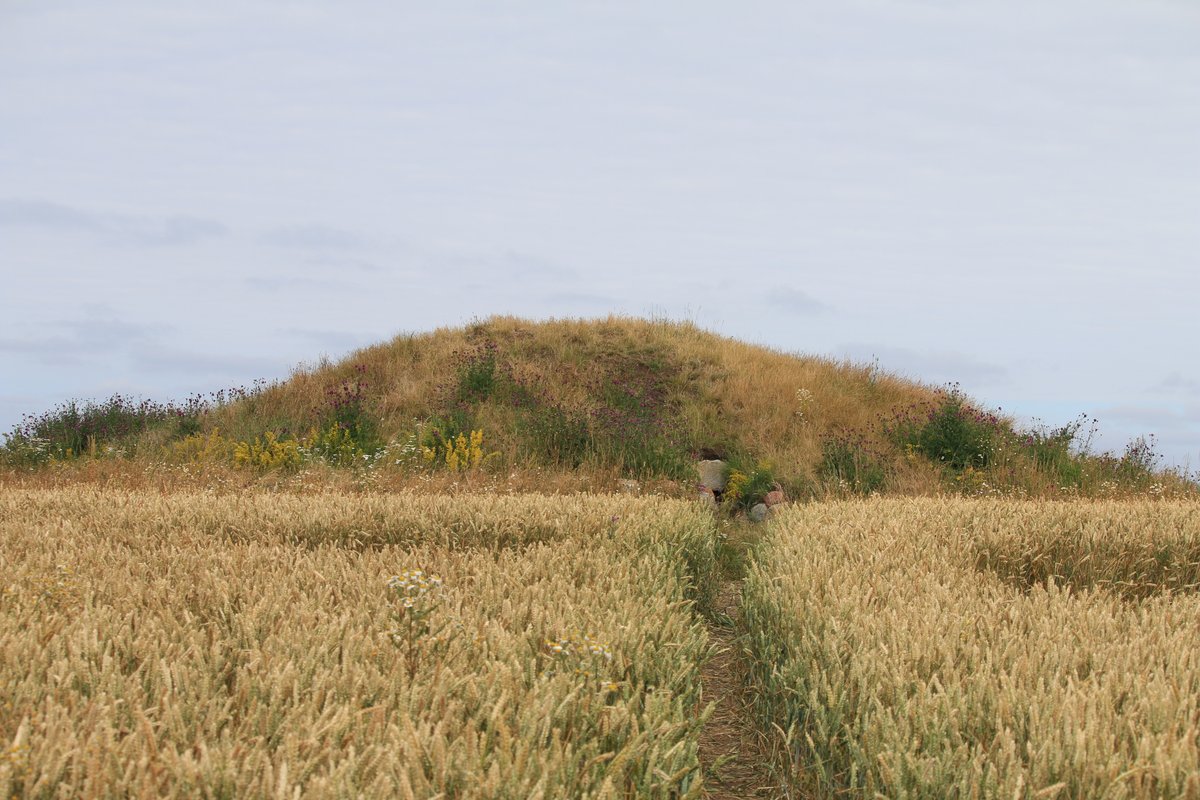

Hidden in plain sight in the vicinity of Glumslövs kyrka, Örenäsgånggriften is a well-preserved chamber grave that dates back to around 7500 years ago. This extraordinary archaeological site, discovered in 1843, is an example of the trattbägarkulturen, a Neolithic culture that spanned Sweden. The grave is enclosed by four gavel stones and seven stones on each long side, as well as three capstones. A six-meter long passage leads out from the east side of the chamber, enclosed by six side stones and three capstones on each side and three capstones on the top.
Cup-marks can be found on the largest capstone. After its discovery, the grave was investigated by Sven Nilsson who found pottery shards, axes, mallets, arrows, and a flint arrowhead in the chamber. In 1907, C. Wibling excavated the grave, resulting in the discovery of further finds, including the remains of seven skeletons. The chamber and its surroundings were investigated again in 1951-1953, when approximately 10,000 shards of pottery belonging to the trattbägarkulturen were found, dating the grave to the younger Stone Age. Just under two meters east of the chamber, there are four stones that are the remains of a cist grave.
Sources: Wikipedia, OpenStreetMap, Wikidata, Wikimedia Commons
Written by Nik Frost
Discuss this with the author and others
No comments yet. Be the first to start the conversation.