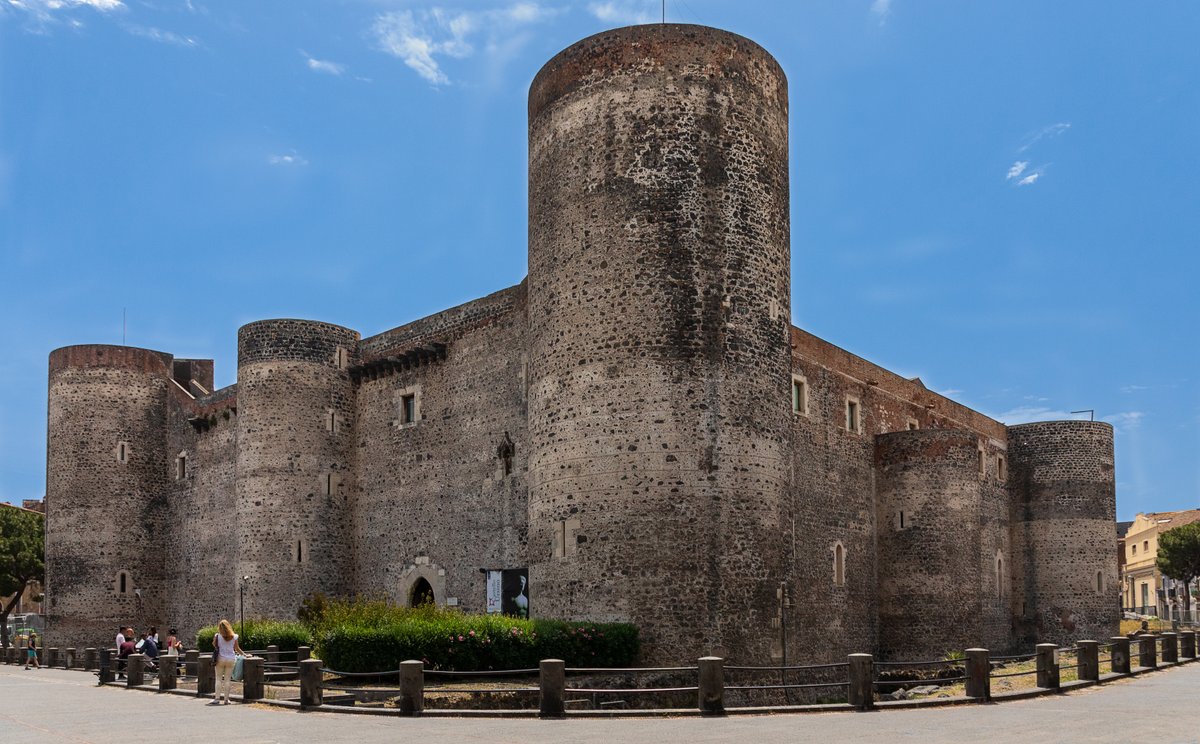

Castello Ursino, also known as Castello Svevo di Catania, is a striking historical edifice in Catania, Sicily, Italy. Originally constructed between 1239 and 1250, this imposing 13th-century structure was built under the rule of Emperor Frederick II, King of Sicily, as a symbol of royal power and a defense to consolidate his power after the death of his predecessor, William II. Its impressive history, filled with power struggles, kings, and kidnappings, makes it a must-visit today.
### Construction The castle was built as a symbol of royal power and a defense, equipped with state-of-the-art military technology of its time.
### Sicilian Vespers In 1295, the castle played a significant role in the Sicilian Vespers, when the Parliament which declared deposed James II of Aragon as King of Sicily was held here. The following year, it was captured by Robert of Anjou but was later again in Aragonese hands.
### Royal Residence Over the years, various kings resided in the castle, including King Frederick III, Peter II, Louis, Frederick IV, and Maria. One memorable event from its history took place in 1392, when Maria was famously kidnapped from the castle by Guglielmo Raimondo III Moncada to avoid her marriage with Gian Galeazzo Visconti.
### Time as a Prison and Museum After the period of royal residency, the castle lost its military role and was used as a prison. During the earthquake of 1693, it was one of the few buildings in Catania to survive, and it's now open to the public as a museum. Visitors can explore artifacts such as the Julia Fiorentina inscription from the Louvre and statues of various important figures, though there is no statue of Ignazio Paternò Castello Principe di Biscari in the castle.
Sources: Wikipedia, OpenStreetMap, Wikidata, Wikimedia Commons
Written by Nicolo Ciampini
Discuss this with the author and others
No comments yet. Be the first to start the conversation.