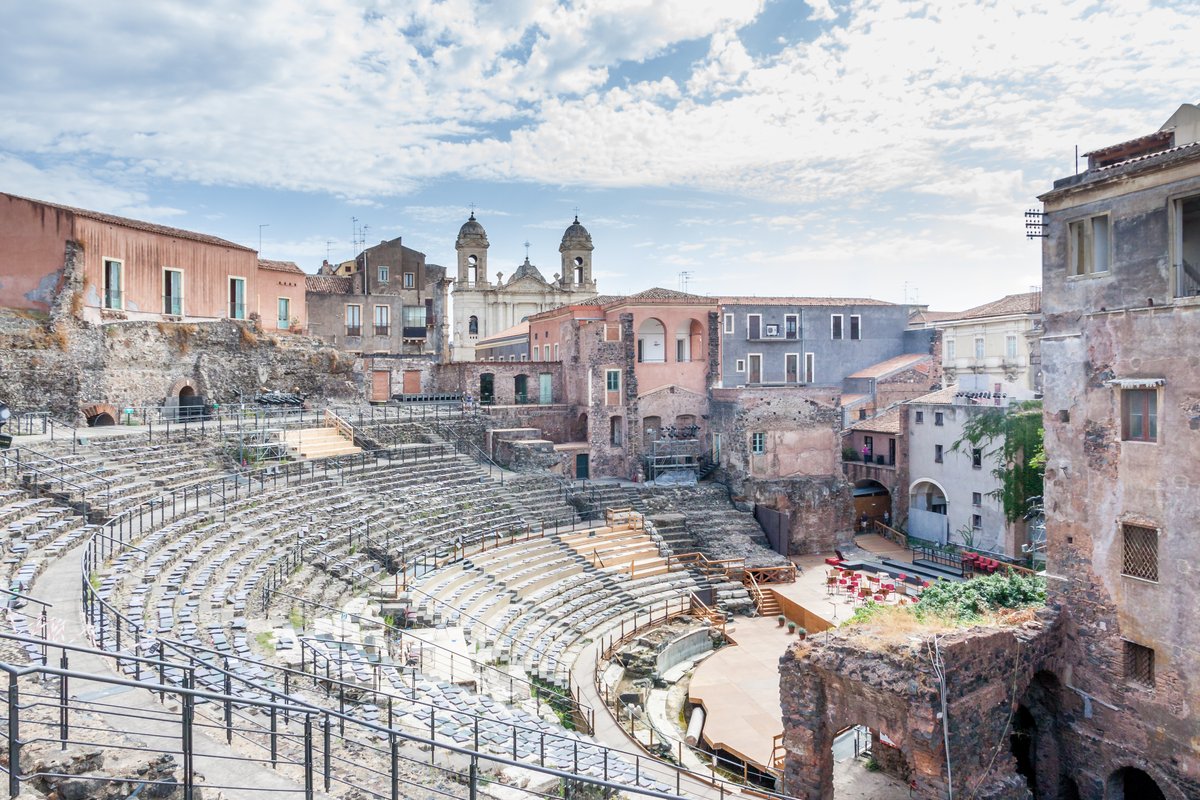

Two theatres, one larger and one smaller, are built into the heart of Catania, Sicily, southern Italy, one of the two open-air semicircular Roman theatres that still stand. The Roman Theatre is the larger of the two, and it seats nearly 7,000 spectators, fewer than the theatres at Taormina and Siracusa by 1,000-3,000 seats. It was likely built in the second century AD and only fully excavated in the 19th century. The theatre follows a common design of many ancient Roman theatres: seats rising along the hillside, spectators facing south and having a spectacular view of the sea, marble columns for depth and complexity.
The orchestra or stage section had a diameter of nearly 22 meters. The auditorium (cavea section) originally measured 98 meters deep, consisting of 21 rows of seats divided into wedges or cunae. It was likely built for spectators to watch plays and recitations, seated comfortably, on arts that took them away to the sea. Some of the marbles and artefacts recovered during excavations are on display in the adjacent Casa Pandolfo and Casa Liberti.
Sources: Wikipedia, OpenStreetMap, Wikidata, Wikimedia Commons
Written by Nicolo Ciampini
Discuss this with the author and others
No comments yet. Be the first to start the conversation.