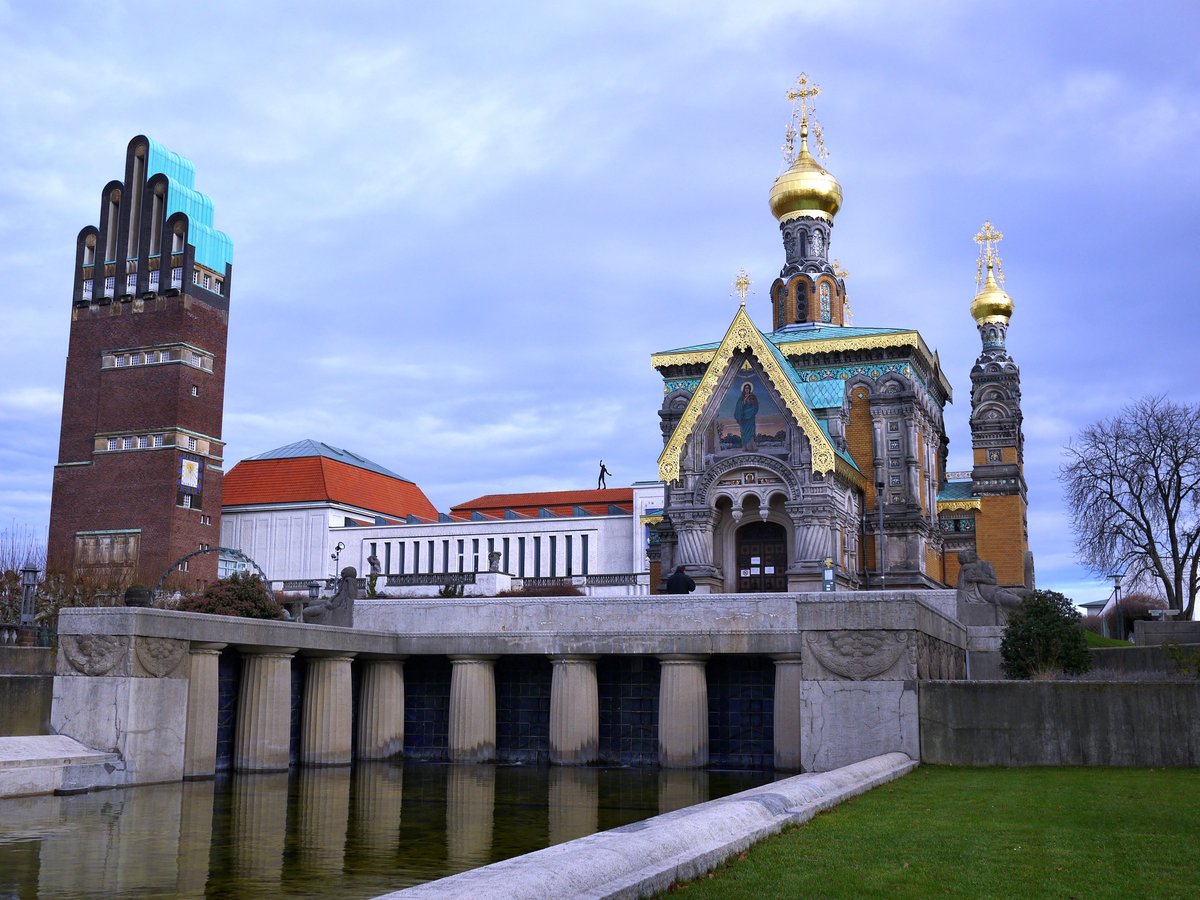
Grand Duke Ernst-Ludwig of Hesse established an artist colony upon a site that served as a court garden designed as an English landscape park starting in 1833. Named for Grand Duchess Mathilde, this site allowed creators to experiment with space. Artists used a holistic approach to experiment with architecture and space art, using the Jugendstil and early Modernist styles.
Joseph Maria Olbrich, Peter Behrens, and Albin Müller lived and worked at the site. Their contributions shaped modernist architecture and urban landscape design. The site is located on a hill that was once used for cultivating wine; around 1800, Prince Christian commissioned a public park on the hill.
Today, the ensemble resides in Darmstadt as a UNESCO World Heritage site. The core area of the site covers a total of 5.37 hectares, consisting of a large area of 5.21 hectares and a smaller area of 0.16 hectares. Twenty-two of the 23 listed objects are located within the main heritage area. A smaller group of three houses is located on the 0.16-hectare plot at the corner of Stiftstraße and Prinz Christian-Weg.
To the west, the Löwentor stands as a gateway. Its lion sculptures originated from the former main portal of the fourth artist colony exhibition in 1914. The park connects to the urban fabric, merging with Park Rosenhöhe and the Großen Woog, an inner-city natural swimming lake.
Sources: Wikipedia, OpenStreetMap, Wikidata, Wikimedia Commons

Written by Aurora
Discuss this with the author and others
No comments yet. Be the first to start the conversation.