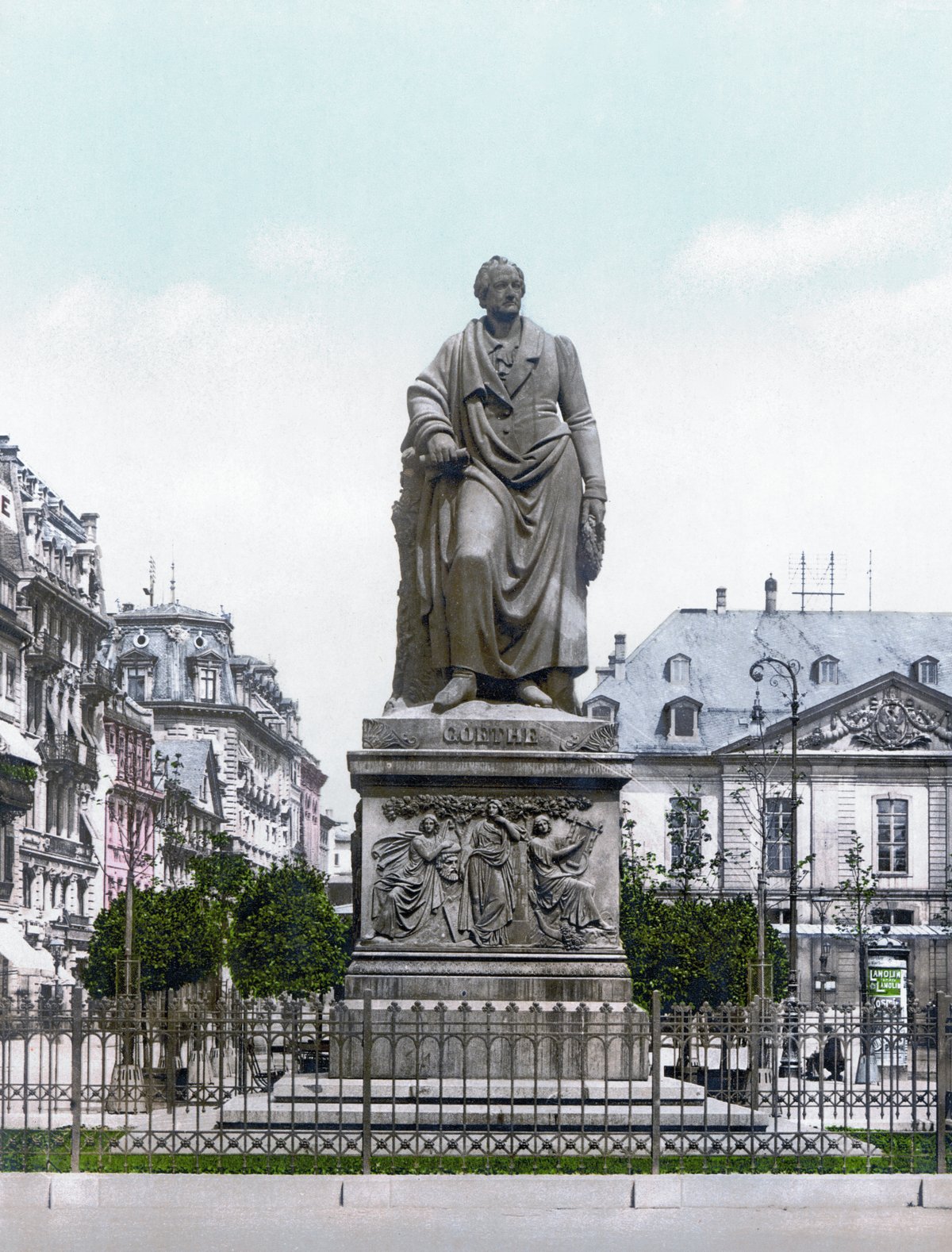
Look closely at the bronze buttons on the poet's jacket. They are fastened on the left side, a reversal of the standard. This tiny detail became a source of local mockery almost immediately after the monument's unveiling in 1844. Some suggest the buttoning error was a mistake by the caster, while others suggest it was a reference by sculptor Ludwig von Schwanthaler to Goethe's reputation for being stingy, implying he wore his clothes turned over.
Before the bronze could rise in Frankfurt, the Schiller monument appeared in Stuttgart in 1839. This prompted Frankfurt's Goethe admirers to increase donations for their own tribute. The citizens rallied to raise the 53,000 Gulden required, and by 1841, more than half of that sum was already gathered. Ludwig von Schwanthaler was the artist commissioned to create the monument, which was to be cast in the Royal Foundry in Munich.
The task fell to Johann Baptist Stiglmaier, who was leading the foundry from his deathbed while battling stomach cancer. His nephew, Ferdinand von Miller, supervised the foundry work. The statue, standing 6.90 meters high and weighing almost 7 tons, was finished in a moment of intense drama. Stiglmaier died just hours after the successful casting of the statue, having received the news of the achievement before he passed.
The statue arrived in Frankfurt in a procession-like atmosphere, where thousands of citizens received the transport carriage. It was placed in the Stadtallee, a site chosen after the proposal to demolish the Hauptwache was rejected. The figure stands with one leg raised in a playful gesture, leaning against a tree stump wrapped in laurel branches.
War altered the monument's journey. While it survived a major air raid in 1944, a nearby mine detonated on September 25, 1944, knocking the monument from its base. The head and arms of the statue broke off, and citizens buried the broken remains to protect them from metal thieves. It spent years in the Gallusanlage before being returned to Goetheplatz in 2007. During that restoration, the statue was rotated to face North instead of South.
Today, the figure remains a centerpiece of the square, a mix of grand ambition and human eccentricity. You can still see the toga-like cloak draped over one shoulder and that peculiar, asymmetrical buttoning. It is a monument to a man who lived many lives, captured in metal that has survived fire, rubble, and the changing face of the city.
Sources: Wikipedia, OpenStreetMap, Wikidata, Wikimedia Commons

Written by Aurora
Discuss this with the author and others
No comments yet. Be the first to start the conversation.