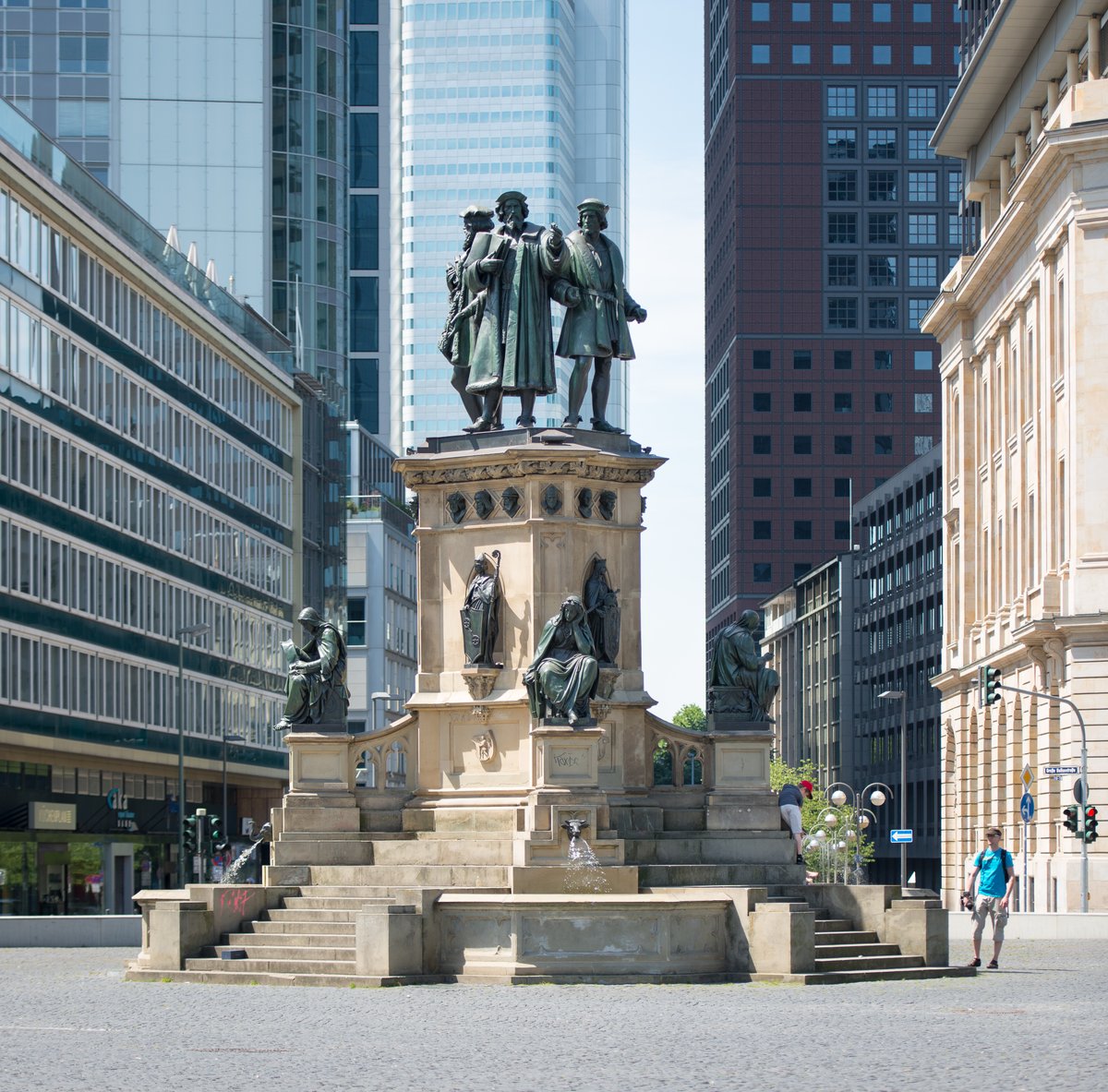
A copper coin, an obol, was once the price of admission to witness the ghosts of the printing press. In the mid-19th century, before the permanent monument occupied this space in Frankfurt's Roßmarkt, the public could pay this small fee to view plaster casts of three printers. These casts were modeled after terracotta figures created in 1840 to mark four centuries since the invention of movable metal letters. The money gathered from these curious spectators eventually financed the grand sandstone and bronze structure that stands here now.
The story began with a temporary celebration in 1840. The sculptor Eduard Schmidt von der Launitz was commissioned to create terracotta statues of Johannes Gutenberg, Johannes Fust, and Peter Schöffer. They were intended to honor the men who worked together in Frankfurt to turn the tide of human communication. During those festivities, printers of the Vormärz period marched through the city streets with a defiant slogan: "You gave Your work to the people as a weapon, so that it might create justice and freedom!" The atmosphere was heavy with the scent of impending change, with the March Revolution arriving just eight years later.
To turn these temporary figures into a permanent fixture, the sculptor Georg Ludwig von Kreß created plaster casts of the 1840 originals. A physicist named Rudolf Christian Böttger then developed a technique called galvanoplastik to coat these casts in bronze. This technical transition allowed the figures to survive the elements. The final monument was inaugurated on October 20, 1858, replacing a fountain dedicated to Hercules that had previously occupied this spot.
Sandstone forms the base and plinth, rising to a pedestal where the three printers stand in quiet company. Beneath the capital of this pedestal, a frieze holds fourteen heads - a gallery of faces representing different centuries of publishing history. It includes figures like Will Caxton, Aldus Manutius, and Didot, alongside the sculptor himself. The walls of the pedestal display the coats of arms for Mainz, Frankfurt, and Strasbourg, alongside the coat of arms of Venice, a vital printing hub of the Renaissance.
Below the pedestal, four allegories describe the pillars of human endeavor: Science, Industry, Poetry, and Theology. From these allegories, water spouts in the shape of animal heads emerge during the warmer months. They represent the four continents of the era: a bull for Europe, a lion for Africa, an elephant for Asia, and a llama for America. These figures pour water into four basins, a rhythmic cycle of motion and history at the heart of the town.
Johannes Gutenberg himself lived in Frankfurt for a brief window between 1454 and 1457. While he is famous for the Bible, his time here was marked by practical production. He purchased lead and a press specifically to cast pilgrimage mirrors for the journey to Aachen, allowing pilgrims to carry home the reflected light of the relics. In the same city, he also printed the Turkish calendar, the crusade bull of Pope Calixt III, and the very indulgence letters that would later become subjects of great historical debate.
Sources: Wikipedia, OpenStreetMap, Wikidata, Wikimedia Commons

Written by Aurora
Discuss this with the author and others
No comments yet. Be the first to start the conversation.