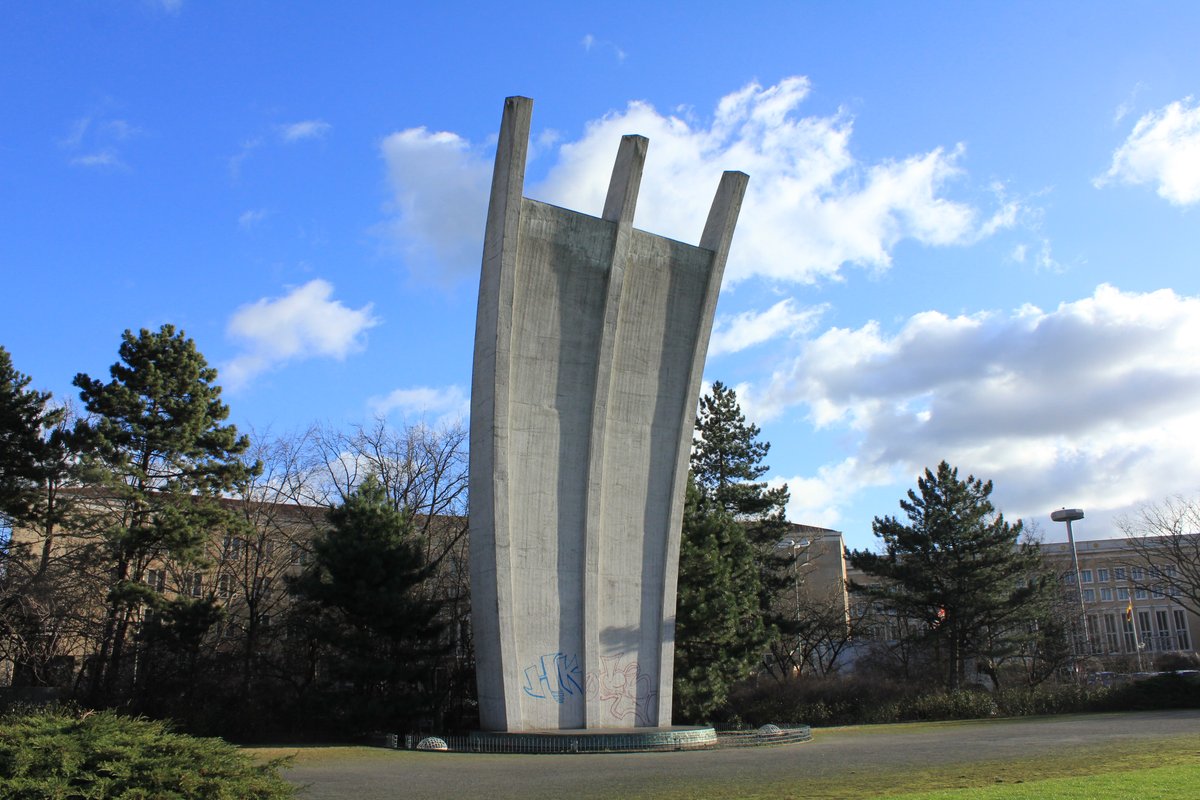
Berliners name the Hungerharke or Hungerkralle. This grey-faced concrete arch stretches like claws. Cast to remember the victims of the Berlin Airlift, it stands where the Soviet occupation force blockaded West Berlin in 1948.
In 1951, the monument was inaugurated at Platz der Luftbrücke in front of Tempelhof Airport. Three ribs symbolize air corridors sustaining life. They link Tempelhof, Gatow, and Tegel toward occupation zones in Frankfurt am Main, Hannover, and Hamburg.
Time and purpose reside in the base. A semi-circular pedestal of concrete and travertine supports a bronze band. The band bears the inscription: 'Sie gaben ihr Leben für die Freiheit Berlins im Dienste der Luftbrücke 1948/1949'. The monument lists the ranks and names of all those who died in flight or loading accidents.
This story traveled beyond city limits. In 1985, the Luftbruecke Chapter of the Airlift Tanker Association e.V. raised 940,000 Mark for a monument at the former Rhein-Main Air Base in Frankfurt. A smaller version of the sculpture was created at the former Royal Air Force Station Celle.
Today, the site remains a listed cultural monument. The last two flights from Tempelhof Airport before its closure in October 2008 were a Douglas DC-3 and a Junkers Ju 52/3m D-AQUI.
Sources: Wikipedia, OpenStreetMap, Wikidata, Wikimedia Commons

Written by Aurora
Discuss this with the author and others
No comments yet. Be the first to start the conversation.