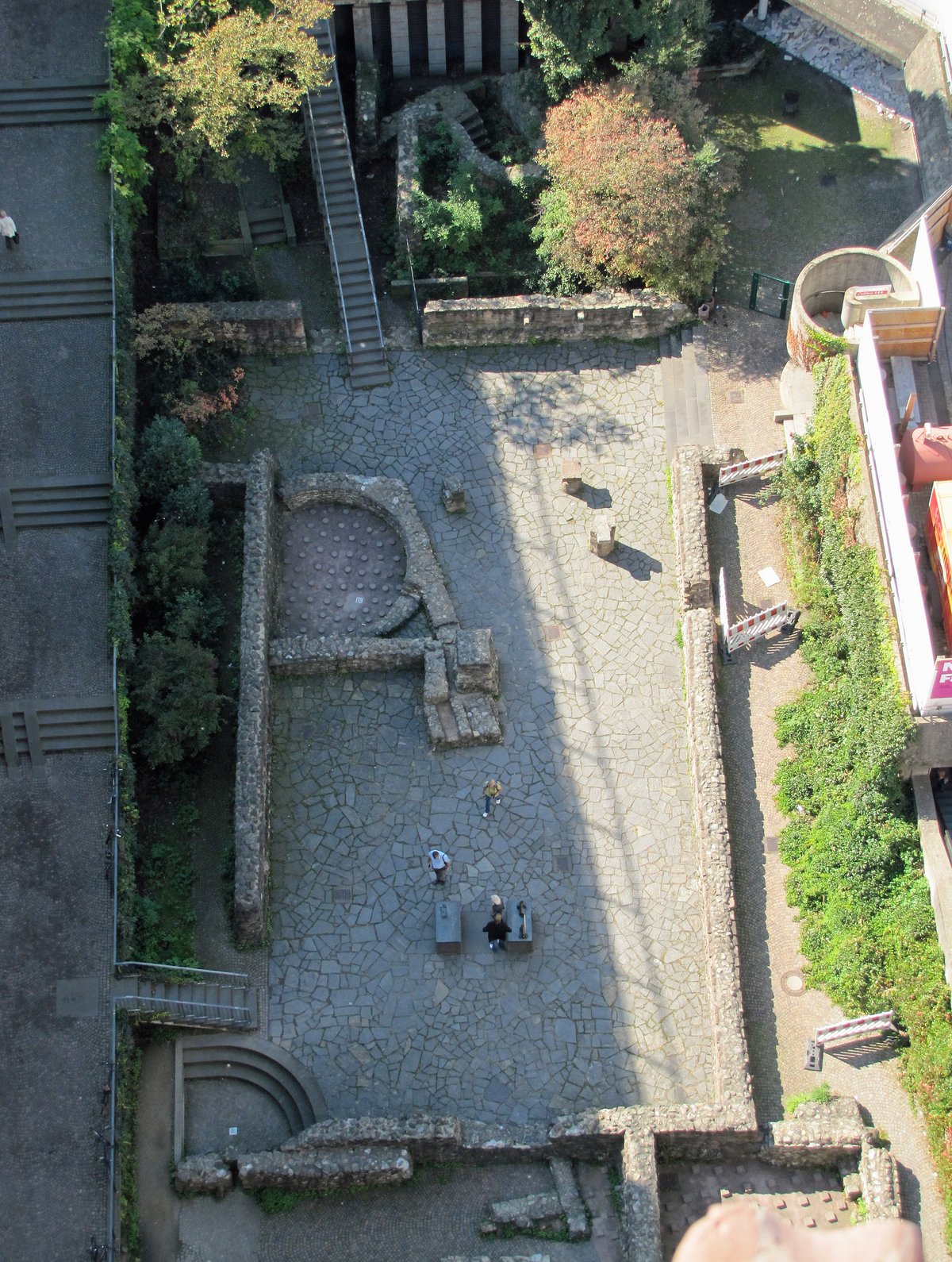
A 15-meter-long 'Königsgang' lies here, the wall remains of a royal palace connecting to a predecessor church. The foundations of the 'Königsgang' were first uncovered since the 1950s during the preparatory works for the covering of the site.
This ground holds a heavy lineage of power. It contains the remains of a Roman settlement on the Domhill, a Merovingian royal court, a late medieval cellar, and the sprawling complex of the Carolingian-Ottonian royal palace. This was the seat of the Kaiserpfalz, the imperial palace of Frankfurt.
In the year 794, the air here would have carried the weight of Frankish politics. High-ranking church representatives gathered for the Synod of Frankfurt in June of that year, while the oldest written record of the city was drafted in February. Charlemagne himself issued a decree in 794 to donate fields and meadows to the St. Emmeram monastery in Regensburg. Scholars believe this text was likely drafted within a predecessor building to the palace, using the spelling 'Franconofurd' found in the oldest records of the town.
To protect these ghosts from the weather, the city moved to cover the site. In 1972 and 1973, the site was created during the construction of the U-Bahn station. However, by 2013, the authorities decided to build a permanent roof over the site. They placed wooden hoods over the ruins in May 2013 as a final shield before the Stadthaus am Markt was constructed over the excavations between 2013 and 2016.
Today, the palace has moved indoors. The site is now known as the Kaiserpfalz Franconofurd, an exhibition in the basement of the new building. The foundations of the ruins, including the king's walk, are integrated into the lower rooms as permanent exhibition pieces. Visitors can see a two-meter-tall bronze model of the palace as it stood around 860 AD, along with large 3-D graphics that reconstruct the Roman road station and the Carolingian palace in digital light.
Walking through these rooms, you are standing in the cellar of the modern city, looking at the bones of the old one. The palace is no longer a ruin exposed to the rain. It is a preserved basement of history, where the foundations of the 9th century serve as the literal floor for the 21st.
Sources: Wikipedia, OpenStreetMap, Wikidata, Wikimedia Commons

Written by Aurora
Discuss this with the author and others
No comments yet. Be the first to start the conversation.