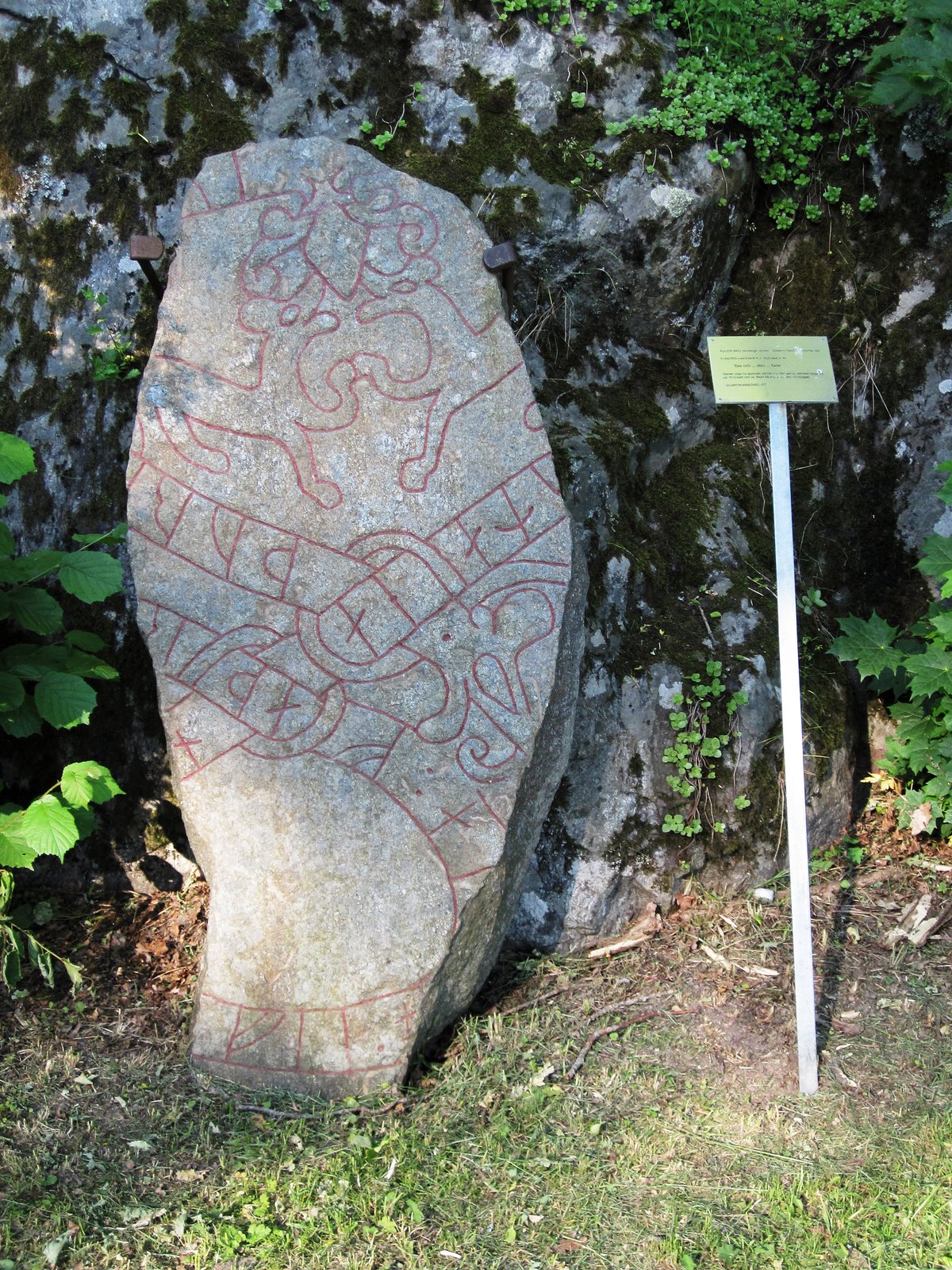

Ågestastenen is a rune stone situated at the junction of Norrån and Ågestavägen, at the village Stora Mellansjö in Ågesta, Huddinge commune on Södertörn. Erected in the 1,000s, it originally stood along the route that crossed the river (today's Norrån) between Magelungen and Ågestasjön. Originally painted in black, white, red, and blue, the stone was broken apart when a stone bridge was built in the 1850s.
Today, only a larger fragment of the stone, made of coarse-grained gneiss, remains. Pieces of the broken stone were salvaged and repaired in later times; the result now stands next to a small rock pile near the road. The stone is adorned with two animal figures, whose symbolism and identities remain a subject of many theories without final results. Between the heads of these two animals is a palmette, considered a life tree symbol. Both the animals and the palmette served as the basis for the emblem of the Huddinge Hembygdsförening, created in 1970.
It is believed to be related to another rune stone, Sö 290, situated on the north-eastern side of Magelungen near Farsta farm. The individuals mentioned on both stones likely belonged to the same family, and their farm was probably located somewhere along the eastern bank of Magelungen.
Sources: Wikipedia, OpenStreetMap, Wikidata, Wikimedia Commons



Written by Nik Frost
Discuss this with the author and others
No comments yet. Be the first to start the conversation.