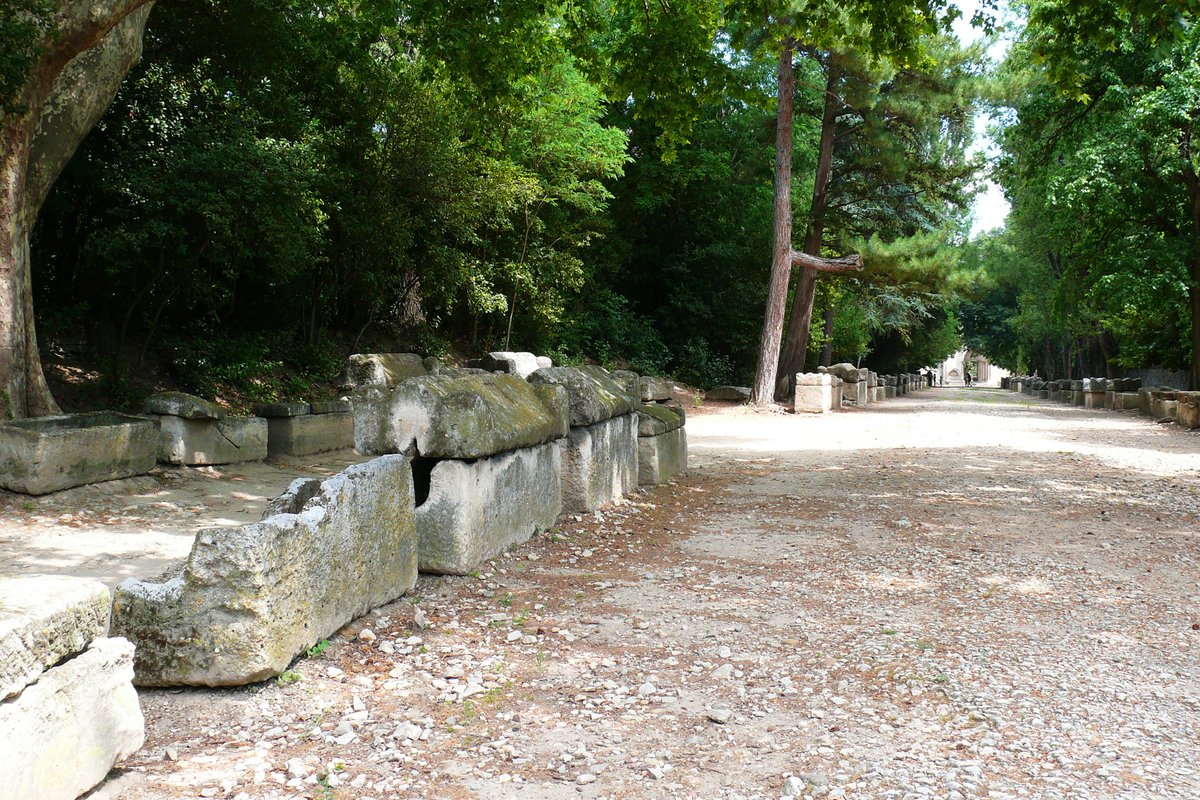
Resting just outside Arles in France, the Alyscamps, once known as Aliscamps from the Provençal Occitan word, takes its name from the Latin Elisii Campi, or Champs-Élysées - the Elysian Fields. These pompous tombs, stretching far and wide, were constructed with the hope of securing salvation in the afterlife. The Alyscamps rose to prominence with the burial of Saint Genesius, a Roman official who lost his head for his refusal to persecute Christians.
Soon after, Saint Trophimus, the city's patron saint, was also laid to rest here, drawing more visitors. While neither saint is thought to hail from the region, it's said that bodies have been buried here since the 4th century. The Alyscamps gained such popularity that bodies were imported from all across Europe. By the 4th century, it became so chic to be buried in the Alyscamps that bodies were shipped from every corner of the continent. However, the removal of Saint Trophimus' relics to the cathedral in 1152 did reduce its prestige.
The necropolis was plundered extensively during the Renaissance, with city councillors giving tombs as gifts and local residents using funerary stones as building material. It was further harmed by the advent of the railway and a canal in the 19th century. Vincent van Gogh and Paul Gauguin selected the Alyscamps as their initial destination for their excursions in late October 1888, painting side by side. After some restoration, it now serves as an open-air museum.
In his final book Caesar's Vast Ghost, Lawrence Durrell advises visiting the Alyscamps for its beauty and ambience, remarking: 'It is unique in its charm.'
Sources: Wikipedia, OpenStreetMap, Wikidata, Wikimedia Commons
Written by Nicolo Ciampini
Discuss this with the author and others
No comments yet. Be the first to start the conversation.