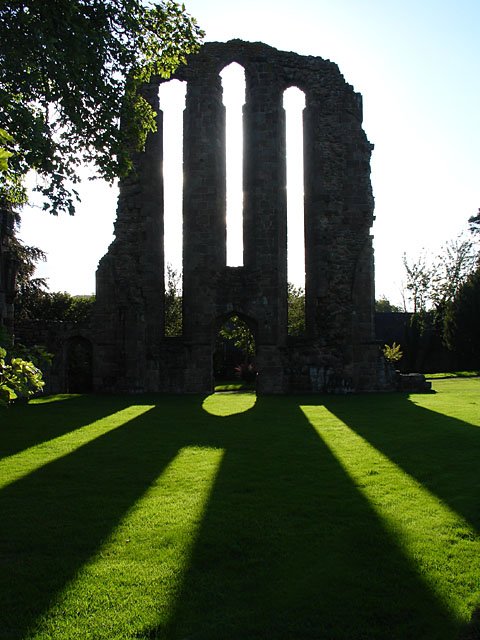
Bertram III de Verdun, a knight in Staffordshire, established Croxden Abbey around 1176 with the aim of securing eternal redemption for his family's souls. He chose the marshy area of Croxden, which he had drained himself, as the site for his Cistercian abbey. Founded as a daughter house of a Cistercian abbey in Aunay-sur-Odon, Normandy, Croxden Abbey experienced prosperity in the 13th century, with income from sheep farming and an export of more wool to the continent than any other religious house in the county by 1315.
However, Bertram was restless, and in 1179 he moved the abbey to a site near a water mill. Bertram died in 1187, and his wife, Rohais, followed him the same year. After Bertram's death, the abbey was relatively stable, but it was closed by King Henry VIII in 1538. Today, the site of Croxden Abbey is managed by English Heritage, with the west wall, including two doorways and lancet windows, still standing almost complete.
Sources: Wikipedia, OpenStreetMap, Wikidata, Wikimedia Commons
Written by Nicolo Ciampini
Discuss this with the author and others
No comments yet. Be the first to start the conversation.