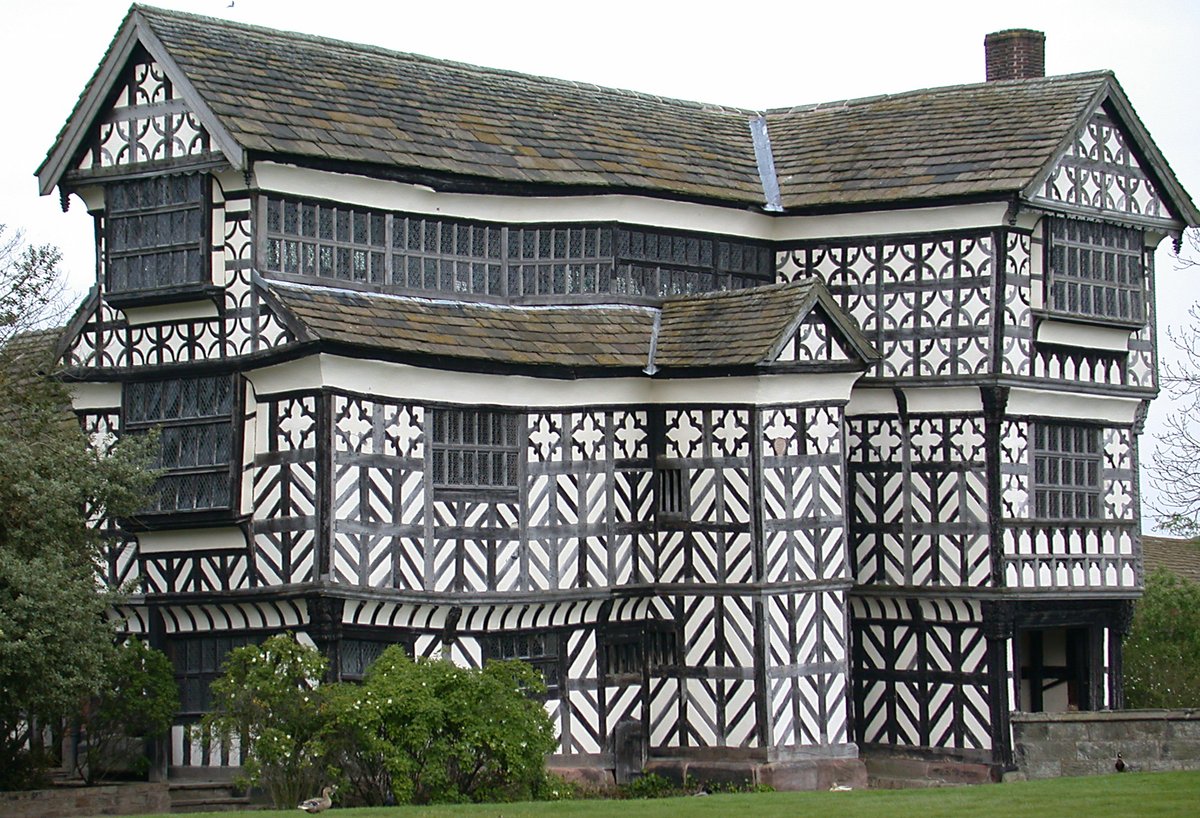
Little Moreton Hall, also known as Old Moreton Hall, is a manor house 4.5 miles (7.2 km) south-west of Congleton in Cheshire, England. The earliest parts of the house were built by William Moreton around 1504 and the remainder was constructed in stages by successive generations of the family until about 1610. The half-timbered building is highly irregular, with three asymmetrical ranges forming a small, rectangular cobbled courtyard. A National Trust guidebook describes Little Moreton Hall as being ‘lifted straight from a fairy story, a gingerbread house.' The house's top-heavy appearance, ‘like a stranded Noah’s Ark’, is due to the Long Gallery that runs the length of the south range’s upper floor.
The house remained in the possession of the Moreton family for almost 450 years, until ownership was transferred to the National Trust in 1938. Little Moreton Hall and its sandstone bridge across the moat are recorded in the National Heritage List for England as a designated Grade I listed building; the ground on which Little Moreton Hall stands is protected as a Scheduled Monument. The house has been fully restored and is open to the public from April to December each year.
At its greatest extent, in the mid-16th century, the Little Moreton Hall estate occupied an area of 1,360 acres (550 ha); it contained a cornmill, orchards, gardens and an iron bloomery with water-powered hammers. The gardens lay abandoned until their 20th-century re-creation. As there were no surviving records of the layout of the original knot garden, it was replanted according to a pattern published in the 17th century.
Little Moreton probably derives from the Old English mor (marshland) and ton (town). The area was named Little Moreton to distinguish it from Greater Moreton.
Sources: Wikipedia, OpenStreetMap, Wikidata, Wikimedia Commons
Written by Nicolo Ciampini
Discuss this with the author and others
No comments yet. Be the first to start the conversation.