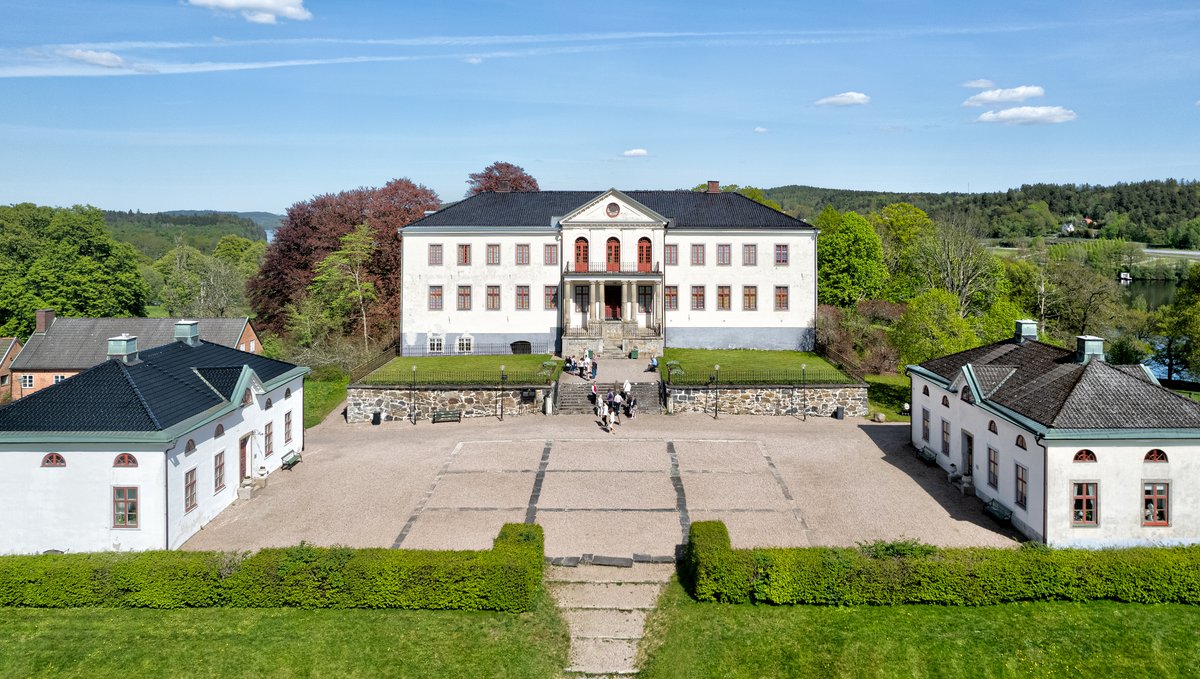

Nääs Castle sits between Sävelången Lake and the village of Lerum, in Skallsjö parish, Västergötland, and has a rich history of over 500 years. What starts as a royal hunting lodge in the late 1500s, built by Joen Småswen, evolves into a mecca for Swedish crafts education a few centuries later. The foundations of Nääs were first laid by Joen Småswen in the late 1500s. During the next century, it would pass through several noble families, including the Ulfsparres, Lilliehööks, Natt och Dag, Cronsköld, Oxenstierna, Göthenstierna, von Utfall, and Reenstierna.
In 1824, Peter Wilhelm Berg, a wholesaler from Gothenburg, purchased the estate. His son Theodor and daughter Nensy inherited the Nääs factories upon his death, while Gottfrid, the youngest son, received the rest of the estate, including the mansion. Gottfrid made significant changes to the estate, setting up the Nääs School of Art and Craft, which would later become known for its groundbreaking contributions to the European craft scene. In 1868, August Abrahamson, another Gothenburg wholesaler, acquired the mansion and transformed it into a museum, run by the August Abrahamson Foundation he established.
Today, this foundation manages around 60 buildings and approximately 1,500 hectares of land. Visitors to Nääs Castle can explore the museum open to the public between May and September. The estate also offers art and craft courses, bed and breakfast accommodations, and conference facilities. But beneath the sprawling estate, the spirit of the Nääs School of Art and Craft still thrives, behind the lake and away from the crowd, waiting to be discovered.
Sources: Wikipedia, OpenStreetMap, Wikidata, Wikimedia Commons
Written by Nik Frost
Discuss this with the author and others
No comments yet. Be the first to start the conversation.