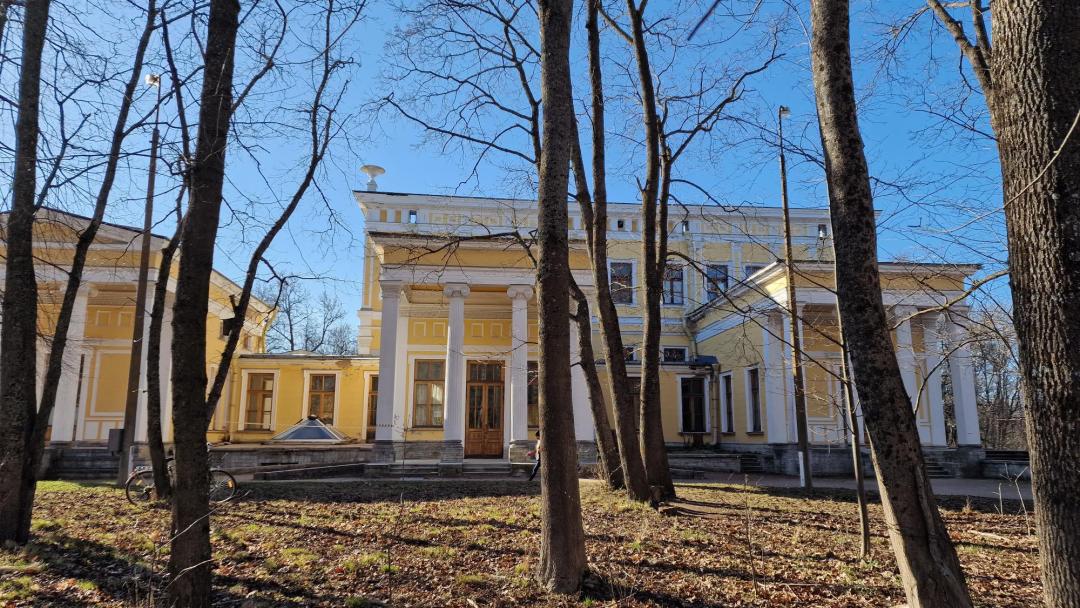
Lost Estates - The Levashov-Vyazemsky Estate

Mezhozyornaya St., 9, Saint Petersburg, Russia, 194362

The Levashov-Vyazemsky Estate is a ruined monument of manor architecture located in the settlement of Osinovaya Roscha (now the Vyborgsky District of Saint Petersburg), at the junction of the Vyborg and Priozersk highways, 4 km from the settlement of Pesochny. It is one of the numerous Petersburg sites placed under UNESCO protection in 1990.

The Levashov-Vyazemsky Estate is a ruined monument of manor architecture located in the settlement of Osinovaya Roshcha (now the Vyborgsky District of Saint Petersburg), at the junction of the Vyborg and Priozersk highways, 4 km from the settlement of Pesochny. It is one of the numerous Petersburg sites placed under UNESCO protection in 1990.

In the 1770s, a miniature villa of Prince Potemkin stood on the Osinovaya Roshcha manor, where Empress Catherine stayed in May 1778. Impressed by the location of the manor, she wrote to Baron Grimm: “Petersburg and the sea are at your feet; before your eyes are all the dachas on the Peterhof road and then lakes, hills, forests, fields, rocks, and huts. An English gardener and architect are in our retinue, and we wandered all day yesterday and, God knows, planted and arranged a lot. Tsarskoye Selo, Gatchina, and even Tsaritsyno are rubbish in comparison to Osinovaya Roshcha in terms of location. Now the whole court lives in a house with ten rooms, but what a view from every window! By God, it is wonderful.”

The estate, with a wooden manor house and service buildings, was formed in the era of Russian classicism at the turn of the 18th and 19th centuries. The manor house was built by order of Princess Lopukhina by architecture professor Beretti in 1828–1830. The manor house of the Zinovievs on the Bogoslovskaya manor was built according to the same project.

The house was built according to a tripartite scheme. The central building (completely destroyed) was topped with a belvedere and decorated with a six-column portico of the grand order. Wide entrance steps, bounded by piers, served as a pedestal for sculptures of sphinxes with the face and chest of a woman and the body of a lion (lost). The portico and belvedere formed a vertical axis balanced by a horizontal one — low, recessed passages (one passage partially preserved) and adjoining service wings (survived as ruins). A semi-rotunda surrounded by an Ionic colonnade bearing the balcony balustrade gave softness to the park facade. The large dining room was located in the middle of the house, its windows and doors facing north. On the sides of the dining room, to the left were the study and library, to the right — the living rooms. On the second floor were living rooms, private chambers of family members, and above the dining room — a ballroom with access to the balcony.

The composition of the Corinthian capitals of the columns in the ballroom includes a female head with the portrait features of Ekaterina Nikolaevna Lopukhina, the founder of the estate.

In 1847, Lopukhin sold Osinovaya Roshcha to Count Levashov. Countess Olga Levashova often hosted supporters of continuing the liberal reforms initiated by Alexander II. Her daughters Ekaterina and Maria Vladimirovna (wife of Prince Vyazemsky) began selling off the estate lands for development in the early 20th century. The last private owner of Osinovaya Roshcha was Maria’s son, Prince Vyazemsky.

During the Soviet era, the manor house was used to accommodate a military unit, then adapted as a rest home. In 1918, by decision of the Petrograd district zemstvo board, a state farm was established on the estate, and an agricultural technical school in the manor. Two years later, the palace and park were handed over to a sanatorium; valuable items were taken to Petrograd, and some property was looted by residents of Levashovo. In 1927, the palace again housed an agricultural school. During the Great Patriotic War, the estate served as a rest home for high-ranking officials; after the war, it housed a military unit. In the 1970s, the estate was leased by the "Electron" institute, which commissioned a restoration project.

On April 4, 1991, the main part of the palace burned down; the right and left wings survived, but over the last 20 years they have also turned into ruins. The palace cellars survived, but every spring some part of the cellar collapses.

Sources:

https://www.citywalls.ru/house22866.html

https://ru.wikipedia.org/wiki/Осиновая_Роща_(усадьба)

Follow us on social media

More stories from Russia: UNESCO Sites or Sites Protected by UNESCO

Oreshek Island (Shlisselburg Fortress) - fortress and prison

X23Q+HJ Shlisselburg, Leningrad Oblast, Russia

The Shlisselburg Fortress almost immediately after being conquered by Peter I lost its military significance, and its casemates began to be used as a state prison.

Dubki Park, Sestroretsk

Dubkovskoye Highway, 77, Saint Petersburg, Russia, 197706

The "Dubki" Park in Sestroretsk owes its existence to Emperor Peter I, who on September 20, 1714, while returning across the Gulf of Finland after the Battle of Gangut, stopped to rest in an oak grove on a cape extending deep into the sea, near the mouth of the navigable Sestra River. Individual oaks growing here naturally were 200–300 years old. In 1717, with Peter's involvement, soil was brought into the grove and several thousand young oak trees were planted to support the development of the naval fleet. This is the northernmost oak forest in Russia.

Naval St. Nicholas Cathedral (Naval Cathedral of St. Nicholas the Wonderworker)

Anchor Square, 1, Saint Petersburg, Russia, 197762

The Naval Cathedral of St. Nicholas (Naval Cathedral of St. Nicholas the Wonderworker) is an Orthodox church in Kronstadt, the last and largest of the naval cathedrals built in the Russian Empire. It was constructed between 1903 and 1913 in the Neo-Byzantine style, designed by architect Vasily Kosyakov. Vasily Kosyakov wrote in 1910: “Since 1902, the construction of the Naval Cathedral—a monument to the naval ranks who perished in the line of duty—has been underway in the city of Kronstadt… The church is being built according to a project approved by the highest authority and throughout the construction process has been the subject of special attention from Their Imperial Majesties.”

Palace (Estate) of the Leuchtenberg Family

Leuchtenberg Palace, Oranienbaum Highway, 2, Saint Petersburg, Russia, 198504

The Leuchtenberg Palace is an estate located on the crest of a coastal bluff in the northeastern part of the "Sergievka" park on the western outskirts of Peterhof. The building was constructed by architect Andrey Ivanovich Stakenschneider for Maria Nikolaevna, daughter of Nicholas I, and her husband Maximilian, Duke of Leuchtenberg.

Derbent Lighthouse

Derbent Lighthouse, Derbent, Republic of Dagestan, Russia, 368600

The Derbent Lighthouse is the southernmost lighthouse in Russia, located in the Dagestani city of Derbent. It is the same age as the Makhachkala lighthouse: both are over 1.5 centuries old. The lighthouse is included in the list of protected monuments of Russia and is part of the UNESCO World Heritage list.

Church of the Savior on Ilyina Street

Ilyina St., 26, Veliky Novgorod, Novgorod Oblast, Russia, 173000

The Church of the Savior on Ilyina Street is a decommissioned Orthodox church in Veliky Novgorod on the Trade Side, built in 1374 and famous for being the only church to have preserved frescoes by Theophanes the Greek. The painting was done in 1378. It is the only church in the world to have preserved frescoes by the Byzantine master who painted about 40 churches. The church's wall paintings are unique and unforgettable for the expressiveness of the characteristics of various figures. The bold, free style of painting gives the church a grand resonance. The church is included in the UNESCO World Cultural Heritage list. The Illustrated Chronicle Compilation states: "In the same year, a stone church of Saint Savior was built on Ilyina Street in Veliky Novgorod." The First Novgorod Chronicle contains a record of the church's creation: "In the year 6882 [1374 AD]. They erected a stone church of Saint Savior on Ilyina Street; and Archbishop Alexei of Novgorod consecrated it, with abbots and priests and the kliros of Saint Sophia."

The Church of the Assumption of the Virgin on Volotov Field - the largest puzzle of modern times

Rechnaya St., 36, Volotovo, Novgorod Region, Russia, 173020

The Church of the Assumption of the Virgin on Volotov Field is an Orthodox church located in the village of Volotovo, Novgorod District, Novgorod Region. It is one of the early examples of stone Novgorod architecture. The church is known for its unique 14th-century frescoes. After the end of hostilities, 1.7 million fragments of fresco paintings remained at the site of the church ruins, which were subsequently conserved. On December 14, 1992, the Church of the Assumption of the Virgin on Volotov Field was included in the UNESCO World Heritage list, and in August 1993, Novgorod restorers began restoration work on the fresco fragments.

Lost Estates: The Taitskaya Estate of the Demidovs

Sverdlov Sanatorium, 2, Sverdlov Sanatorium, Leningrad Region, Russia, 198327

To create a luxurious garden and park ensemble, Demidov invited his sister’s husband — Ivan Yegorovich Starov, a young architect and adjunct professor at the Academy of Arts. Construction began in 1774 and continued until 1786. The formation of the ensemble took place in two stages. In the first stage, a manor house was built on the bank of the Verevka River, and to the west, a complex of utility buildings. Behind a long stone fence was a five-part square, which included the two-story residential wing that has survived to this day, the manager’s house, four stables, a gatehouse, a carriage house, and other structures. An alley led to the manor house, curving around an oval parterre in front of its western facade.

The mosque with a minaret is the only ancient minaret in Derbent.

373G+WC Derbent, Republic of Dagestan, Russia

Currently, in Derbent, only one mosque with a minaret has been preserved, which is called the "Mosque with a Minaret" (Minarya-mesdjidi) or the "Minaret Mosque." It is located in the upper (western) part of the city near the Jarchi-Kapa gate and is the oldest mosque in the city.