

The "Dubki" Park in Sestroretsk owes its existence to Emperor Peter I, who on September 20, 1714, returning across the Gulf of Finland after the Gangut victory, stopped to rest in an oak grove on a cape extending deep into the sea, near the mouth of the navigable Sestra River. Individual oaks growing here naturally were 200–300 years old. In 1717, with Peter’s participation, soil was brought into the grove and several thousand young oaks were planted to support the development of the naval fleet. This is the northernmost oak forest in Russia.
By the tsar’s decree, architect Vann Zwieten designed, and Captain Almazov built a palace, a protective dam, and laid out orchards with fruit trees.

The historical configuration of the Dubkovsky Cape has been significantly altered not only by annual storms and floods that erode the cape but also during the construction of the Totleben (Pervomaysky) fort in the early 20th century. During the fort’s construction, the cape served as a warehouse and transshipment base for building materials and soil, which accumulated there in warm seasons and were transported over the ice in winter to the construction site. The territory was backfilled and the shore leveled. Work on restoring the shores and building protective granite, concrete, and sheet pile retaining walls is ongoing.
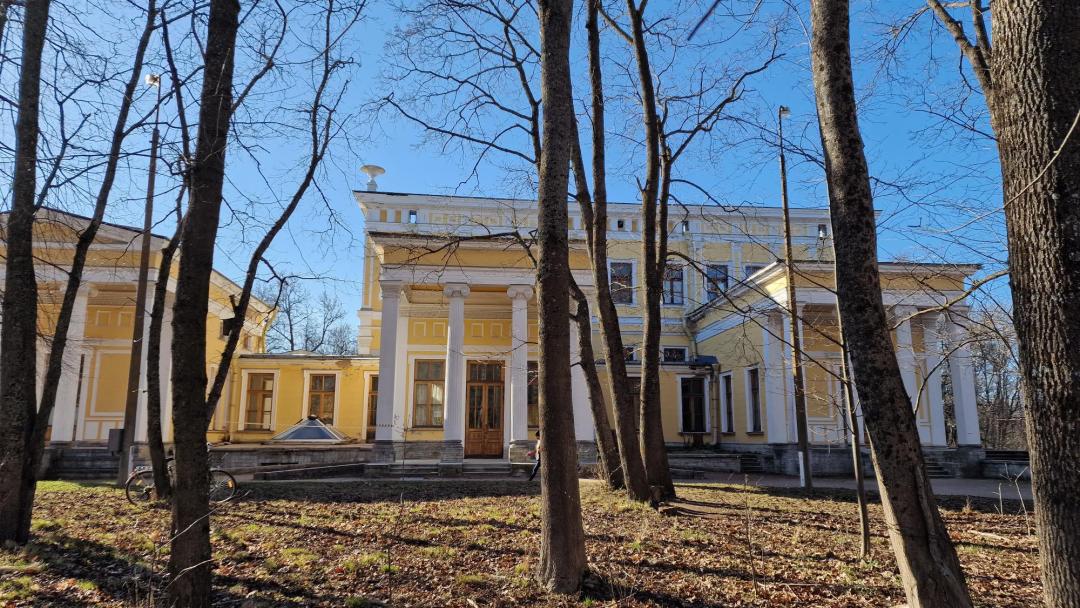
One of the royal residences on the coast of the Gulf of Finland was established on the cape, where Peter I rested during his numerous campaigns and travels. In the early 18th century, one of the country royal residences was briefly located here. The stone three-story palace, connected by galleries to wooden pavilions, was mainly built from 1719 (according to other sources, from 1723) to 1725 and was shown to foreign guests at the Peter’s Assembly on August 28, 1724, the last year of the owner’s life. The building’s decorative effect was achieved through harmony with the landscape, a dynamic facade line, roof contour, and an elegant octagonal lantern tower crowned with a tall spire for raising the imperial standard to a height of 100 feet. The building’s appearance was designed to be viewed from the sea, in the style of “Naval Pomp.” The palace with galleries on the dam spread widely over the sea, with the garden and grove serving as a backdrop.
The total length of the palace without galleries was 62 m, with galleries 185 m, and the height of the spire’s highest point was 30 m. The total area was 1300 m². The building was three stories in the center and two stories at the edges. The main halls on each floor were 170 m². Small rooms (10 m²) were located in the side wings. There were door exits in the inner corners of the courtyard on the garden side. The main entrance was centered through small rooms of the main building on the sea facade side. One of these rooms contained a staircase. The vestibule, also the ceremonial and banquet (assembly) hall of 170 m², was two-storied. On the first floor, there were also 11 rooms (more than 30 in total) connected enfilade with two axes of door openings along the south and north facades. All rooms were heated by stoves and fireplaces. By these parameters, the palace was of medium size compared to previously built palaces in St. Petersburg and Peterhof. The galleries, closely adjoining the ends of the main building, were narrow canopies on light columns arranged in two rows, shifted in pairs in each row, but the central part of the galleries was widened so that the canopy rested on four rows of columns.
History has preserved the names of some individuals involved in creating the imperial residence in the Sestroretsk Dubki: architect Stefan van Zwieten, chamber master, draftsman and Dutch garden arranger François de Waal, gardener Olaf Udelfelt, plaster and stucco masters Antonio Quadri and Semyon Borisov, carpenter master Michel, shingle and roofing master Harman van Boles, roofing master Konstantin Henekrey, carpenters Fyodor Nivin, Efrem Kolpakov, Mikhail Albanov, Matvey Boklinov, and construction supervisor Captain Ivan Semyonovich Almazov.
The architectural historian describes the palace’s creation as follows:
The palace in the Distant Dubki was conceived quite differently; its construction by Van Zwieten was carried out simultaneously with Podzorny. In the Hermitage collection of drawings from the Peter’s era, the master plan of this country estate, which Peter I loved very much and often visited, as seen from the chamberlain’s journal records during the last five years of the sovereign’s life, has been preserved. On this plan, as was customary at the time, the architect marked all the separate buildings of the extensive estate as if from a bird’s-eye view, eleven in total including the main palace. (The drawing bears the inscription: “Copy of the Dubki plan signed by His Imperial Majesty’s own hand, Stevan van Zwieten, May 19, 1722.” The Distant Dubki, so named in contrast to the Near ones, were located directly opposite Peterhof, on the opposite shore of the gulf, about ten versts from Lisiy Nos.) All the buildings here are so simple and visually unremarkable that they resemble a middle-class landowner’s estate rather than a palace. Peter, who, according to contemporaries, disliked large spaces and always lived in small low rooms, built grand palaces more for Europe than for himself personally. Perhaps he wanted to have an intimate corner near Petersburg that had nothing palatial about it and where he could feel like a simple landowner. Such a corner was created for him by Van Zwieten in the Distant Dubki, turning the local oak grove into a Dutch country farm. There was essentially no architecture there, just simple utility “stone boxes” with windows. (Bergholtz recorded in his diary on May 1, 1723: “On this day, at dawn, the emperor went by water to the new pleasure palace, which stands directly opposite Peterhof, in a very pleasant place. It was built about two years ago, and His Majesty, it is said, canceled large constructions at the Strelna estate to use the funds for it.” In August 1724, Bergholtz, together with a group of foreigners, was again at Dubki, where a large garden already existed. That year, some plastering work was still underway.) However, the palace was soon abandoned and later dismantled. (By Catherine I’s decree on March 21, 1727, Van Zwieten was dismissed for “being negligent in his duties.”)

After Empress Catherine I, her heir Peter II moved the capital to Moscow and in 1727, following one of the destructive floods and storms, excluded the palace from the list of royal residences. Due to lack of funds for maintenance, valuable interior details and building materials, including windows, were removed from the palace by Menshikov. The palace became one of the utility buildings (a warehouse) of the Sestroretsk armory. In 1782, the remaining walls were dismantled and used to build the Church of Peter and Paul in the center of Sestroretsk.
The park and Dutch garden layout were created between 1723 and 1725. When laying out the gardens, a well-known Dutch method for reclaiming flooded and shallow sea coasts was used: a protective dam separated the drained shallow water from the sea, cut by drainage canals through which water flowed into a pond and was pumped out to the sea by a “machine standing on the pond.” Historically, this place was called the Dutch garden, which has preserved its original layout to this day, although overgrown with wild plants. The contours of flower beds and bulge greens, as well as channels and small ponds dug 0.5 m deep inside the flower beds, are easily visible when the grass is mowed, even after almost 300 years. According to another version, the garden was named Dutch because of the regular rectangular layout of flower beds and paths. Under Peter, the garden included a vegetable garden, greenhouses, lawns, ponds, and trellises. The soil was imported. Chestnuts, apple trees, elm, boxwood, pear, and cherry trees brought from Sweden were planted in the garden. Borders and trellises made of short-trimmed bushes and small trees were widely used. Sculptures were placed in the centers of the squares with flower beds, surrounded by small trees.
The garden’s main canals were over 6 meters wide and navigable for small boats. There were no bridges. Movement was allowed only by river (sea) transport, which was typical of Peter I.
The protective (Peter’s) rampart was built under Peter I to protect the royal residence and guard against floods. During the threat of the Russo-Swedish War of 1741–1743, the Peter’s rampart was used for defense purposes. The defensive ramparts were strengthened again in 1788 to protect against the troops of Swedish King Gustav III, and they served during the Crimean War on June 14, 1855, when a Russian junior officer was killed during bombardment by the Anglo-French fleet. The Anglo-French landing force did not dare to land. In honor of these events, a chapel was erected in the park in 1858 by local clergyman Labetsky. The chapel was destroyed after 1920.
Later, for defense purposes, entire systems of obstacles for the naval fleet were created in the Gulf of Finland: fascines, piles, stone embankments, etc. Navigation became possible only strictly along the fairway with entry into the sluice channel.
Sources:
https://ru.wikipedia.org/wiki/Дубки_(Сестрорецк)




Written by Jermaine
Discuss this with the author and others
No comments yet. Be the first to start the conversation.