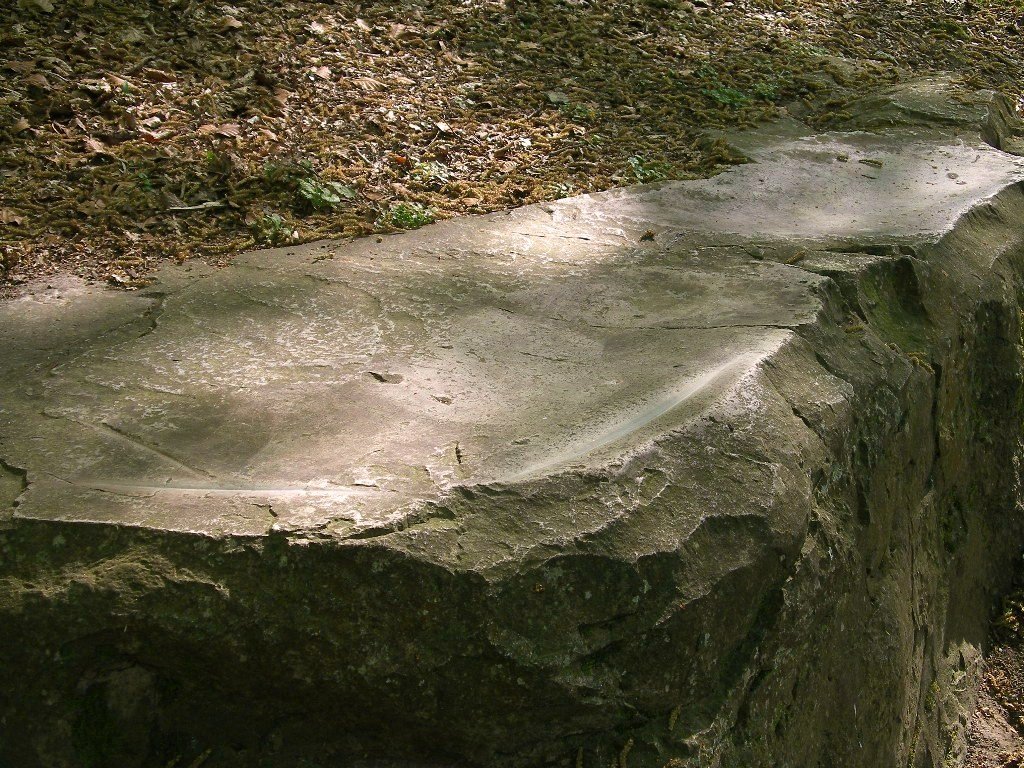

Situated in the picturesque valley of Bons-Tassilly, Calvados, France, the Polissoirs de Poussendre stand as eerie storytellers of a bygone era. The ruins of Mont-Joly at Soumont-Saint-Quentin hint at prehistoric man's presence, but the Neolithic brought a peculiar twist. With the rise of agriculture, the forests gave way to fields, and these peculiar stone tools became welcome members of the community. These mysterious stones, however, were not found in the heart of the forest, but by the river's edge.
These stones, known as the Polissoirs de Poussendre, were no ordinary pebbles. Characterized by deep grooves and distinctive cups, they bore witness to a slow, ritualistic process of silex rubbing. These curious ancient craftsmen seemed to have been quite skilled at their work, and it's fascinating to note that more of these enigmatic stones can be found in the same valley. One such stone, found on the right bank, has been marked as a historic monument, but the date of its recognition remains elusive.
Sources: Wikipedia, OpenStreetMap, Wikidata, Wikimedia Commons
Written by Nicolo Ciampini
Discuss this with the author and others
No comments yet. Be the first to start the conversation.