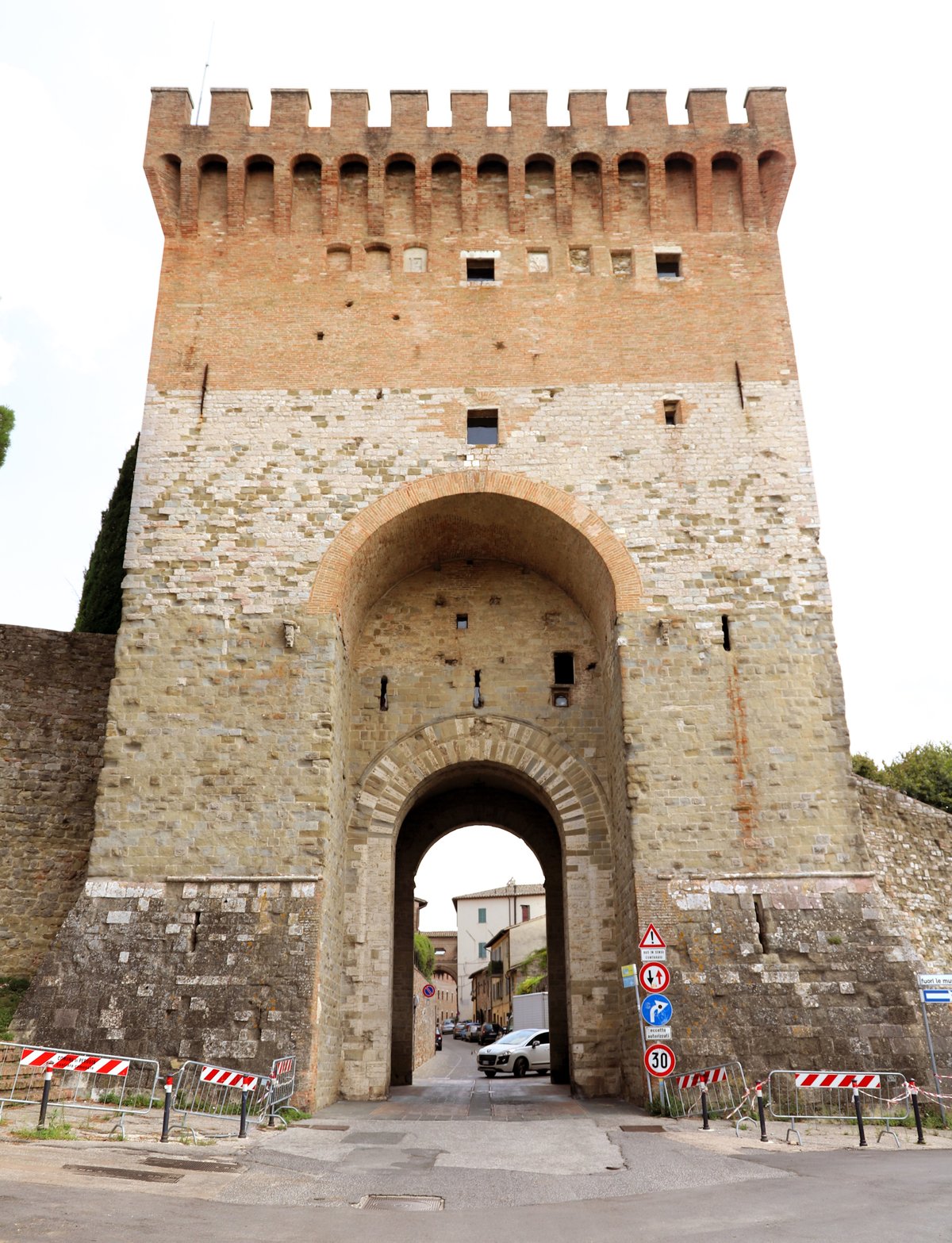

Nestled within Perugia's Sant'Angelo district lies a silent sentinel – not a standard gate, but a tower: the cassero or Porta San Matteo. Constructed in 1325 under the auspices of Lorenzo Maitani, the cassero was part of a second circle of Perugian city walls. Its distinctive construction materials, sandstone at the base, limestone in the center, and brick on top, indicate the time of its creation. Initially conceived as a fortification, the cassero was later expanded, serving as a barracks.
From 1416 to 1424, it underwent renewals under the designs of Fioravante Fioravanti from Bologna. By 1479, it had been transformed into a fortress, complete with portcullis, gun ports, and loopholes. Although no longer serving as a gate, the cassero houses the Museum of Musical Instruments, curated by the Association Arte & Musica nel Perugino. Within its walls, the museum holds rare pieces such as original scores of Carlo Dardocco (second half of the 18th century) and Angelo Galimberti (second half of the 19th century), as well as numerous table fortepianos, baroque and 18th-century flutes, lutes, and 19th-century guitars.
The cassero di San Matteo can be seen in a Perugino painting from 1496-1498, displayed in the National Gallery of Umbria. Adjoining the cassero from the 14th to the 18th century was the Cassero di San Matteo, a work of Matteo Gattaponi – a sight no longer visible today. With its function more as a tower with a sentry role than a door, it stands as a testament to history.
Sources: Wikipedia, OpenStreetMap, Wikidata, Wikimedia Commons
Written by Nicolo Ciampini
Discuss this with the author and others
No comments yet. Be the first to start the conversation.