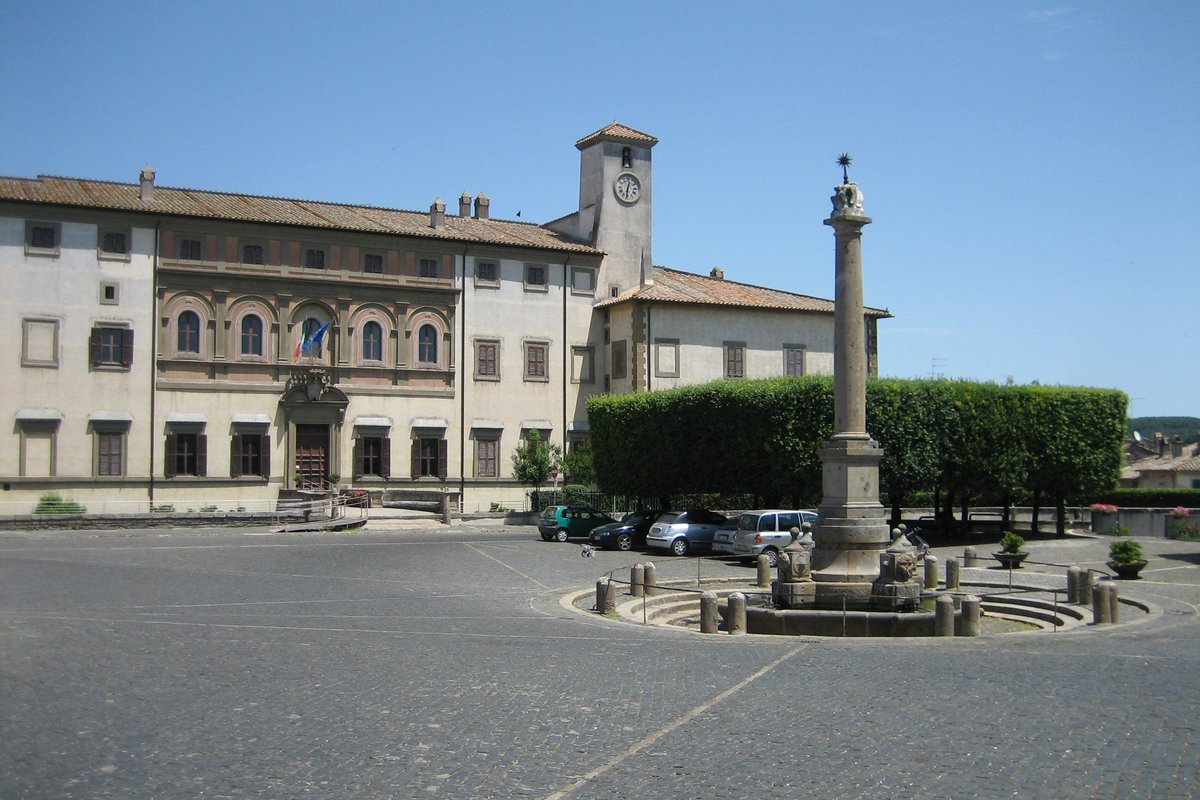

Why did the Italian state step in to buy this place? Well, in 1970, the Altieri family faced enough debt that the heirs tried to auction off everything - the furniture, the books, and the art. To prevent the auction of the palace, the Italian State acquired it through a right of first refusal. Meanwhile, the park was inexplicably excluded from this right and was purchased by a well-known Roman lawyer, only returning to public use in 2010.
The building is a classic example of Mannerist style, built between 1579 and 1585. Tradition attributes the design of the palace and its urban layout to Jacopo Barozzi, known as Vignola, though this attribution is considered very doubtful. The palace reached its current configuration in the 17th and 18th centuries under the Altieri, who added two northern wings to create a large courtyard. They also raised an asymmetrical clock tower and decorated the entrance with a basalt stone bridge.
Walk through the entrance and you hit the Salone degli Avi. It's a real trip - the walls have painted architectural elements and the ceiling features trompe-l'œil that make it look like you're staring straight into the sky. Then there is the Galleria dei Papi. This collection of portraits was so significant that it served as a model for the portraits of the papi di San Paolo that were destroyed after a fire in 1823.
It's a strange, beautiful labyrinth of frescoes and 17th-century furniture that somehow survived the family's financial collapse.
Sources: Wikipedia, OpenStreetMap, Wikidata, Wikimedia Commons

Written by Nicolo Ciampini
Discuss this with the author and others
No comments yet. Be the first to start the conversation.