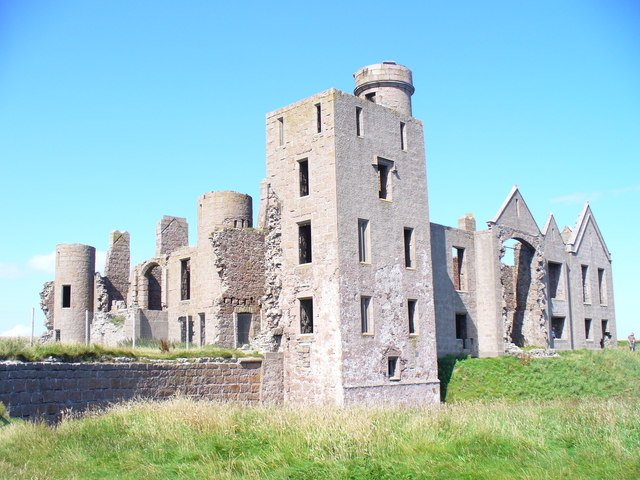

Slains Castle, also known as New Slains Castle to distinguish it from the nearby Old Slains Castle, is a ruined castle in Aberdeenshire, Scotland. It overlooks the North Sea from its cliff-top site one kilometre (5/8 mile) east of Cruden Bay. The core of the castle is a 16th-century tower house, built by the 9th Earl of Erroll. Significant reconstruction has been carried out a number of times, lastly in 1837 when it was rebuilt as a Scots Baronial mansion.
The Hay family had been a powerful dynasty in the area since the 14th century. The 9th Earl of Erroll, a convert to Roman Catholicism, had conspired with other Catholic nobles and was declared a traitor in 1594. Following this, Old Slains Castle was destroyed in October on the orders of King James VI. Erroll eventually returned to royal favour and built a courtyard and square tower on the present site, probably around 1600.
The castle is mentioned in two locally set novels written by Bram Stoker, The Watter's Mou' and The Mystery of the Sea. While it is an internet myth that Stoker got the idea for Dracula from seeing Slains Castle for the first time, the castle may have provided a visual palette for the author when he wrote the novel in Cruden Bay in 1895. A distinctive room in New Slains Castle, the octagonal hall, may be the source for the octagonal room in Dracula. New Slains Castle is a Historic Environment Scotland Category B listed building.
Sources: Wikipedia, OpenStreetMap, Wikidata, Wikimedia Commons
Written by Nicolo Ciampini
Discuss this with the author and others
No comments yet. Be the first to start the conversation.