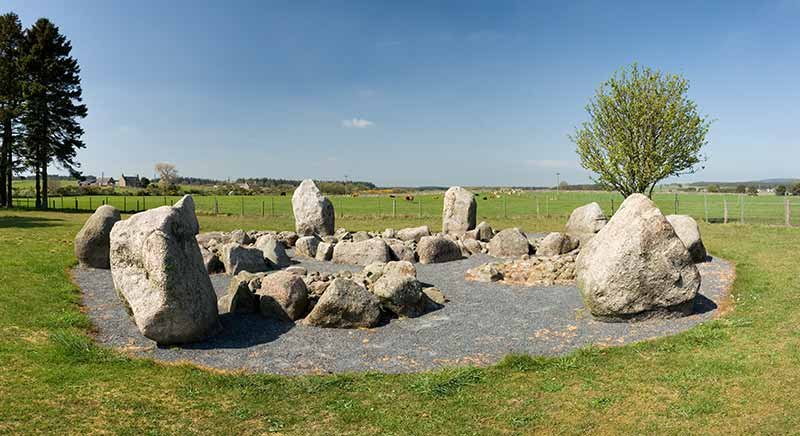
Cullerlie stone circle, also known as the Standing Stones of Echt, sits on a patch of gravel near Echt, Scotland. Consisting of eight irregular stones arranged in a ten-metre diameter circle, they are relics of a distant past. Archaeological excavations in 1934 revealed layers of history in this small Aberdeenshire circle.
Cullerlie stone circle was built as part of a larger stone complex around the second millennium BC. The stones, primarily made of red granite, were transported from far away and arranged to create an enclosure of cairns around a central point. The largest of the stones marks the north side of the circle, and its height varies from 1.09m to 1.80m.
The surroundings of Cullerlie stone circle were once wet bogs. The stones were placed on a higher ground, likely as a display of authority or even as a tool.
A 2004 survey discovered that several stones had designs of cup marks etched into them. These marks, possibly dated back to the Neolithic period, have survived millennia of weather and human activity. They provide evidence of a rich symbolic language created by the people who originally built the stone circle.
The cairns within the circle enclose human remains. These remains indicate that the site had a role as a burial ground in ancient times. However, the exact purpose of the site remains a mystery.
Sources: Wikipedia, OpenStreetMap, Wikidata, Wikimedia Commons
Written by Nicolo Ciampini
Discuss this with the author and others
No comments yet. Be the first to start the conversation.