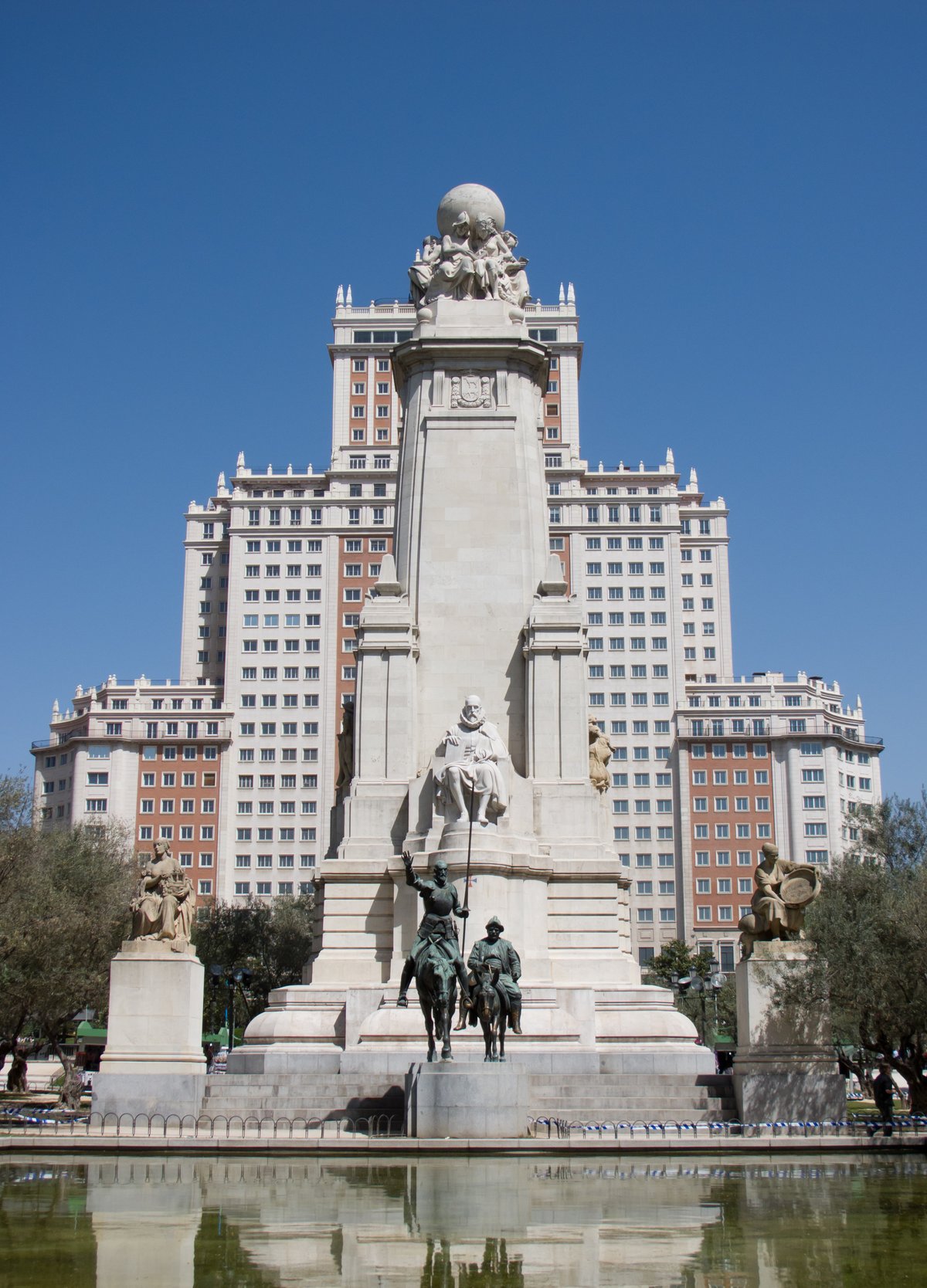

The Monument to Miguel de Cervantes is a prime example of public art located in Madrid, Spain. It stands proudly in the center of the Plaza de España, dedicated to the Spanish writer widely regarded as the greatest, Miguel de Cervantes. However, its creation was not met with the acclaim one might expect. In 1915, a contentious contest was held to determine the project that would bring Cervantes' memory to life. The winning project was awarded to a dark horse proposal by Rafael Martínez Zapatero and Lorenzo Coullaut Valera that had been derided as overly literary, detail-oriented and anecdotal. The jury's decision was criticised via an open letter signed by at least 109 public figures, including Ramón del Valle Inclán and Tomás Borrás.
Despite the criticism, the project moved forward with funding from a popular subscription across Spanish-speaking nations. By the time works started, Pedro Muguruza joined as architect assistant. Standing 34 metres high, the central stone monolith was finished in 1929. At that time, it featured the sculptures representing Cervantes, the allegories of Literature, Military Value and Mysticism and the sculptural group comprised by the Earth Globe surrounded by five women representing the five continents topping the monument, aside from the detached bronze statues of Don Quixote and Sancho Panza. The monument was inaugurated on 13 October 1929.
The Monument to Miguel de Cervantes is now a Bien de Interés Patrimonial, recognized by the Community of Madrid.
Sources: Wikipedia, OpenStreetMap, Wikidata, Wikimedia Commons
Written by Nik Frost
Discuss this with the author and others
No comments yet. Be the first to start the conversation.