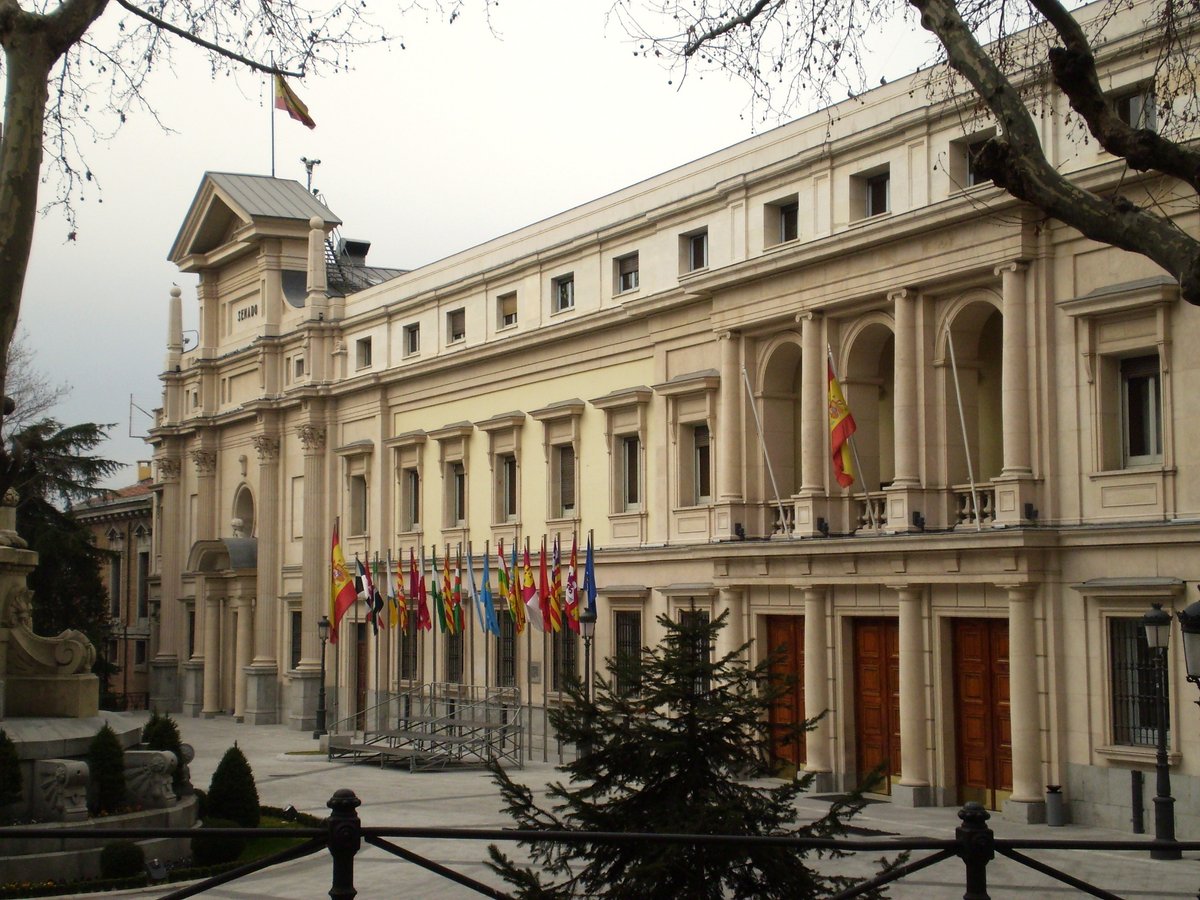

The Palace of the Senate, located in the Spanish Navy Square, in the center of the City of Madrid, was built in the 16th century. Initially, it was the home of Incarnation School or Doña María de Aragón School, a Saint Augustine Order institution recognised as one of the most outstanding in the capital. The school’s church held masterpieces by the legendary El Greco, now displayed in the Prado Museum. In 1814, and later between 1820 and 1823, the palace served as the home of the Cortes of Cádiz, the first official parliament of Spain.
In 1835, the Chambers of Peers moved to the palace and it became the home of the upper house of the Cortes Generales. Over the years, this palace has served as the home of the upper house of the Spanish parliament, until 1923. During the dictatorship of Primo de Rivera (1923–1930), the Cortes were dissolved, and the National Consultative Assembly had its home in the Palacio de las Cortes. With the arrival of the Second Republic, the unicameral parliament established its home at the Palacio de las Cortes and the constitutional debates were held at the Palacio de Cristal del Retiro.
During the dictatorship of Francisco Franco, the palace was the home of the National Council of the Movement, a pseudo Senate controlled by Franco. With the return of democracy in 1977, the Senate was restored in its original home and, along with the Congress of Deputies, wrote the democratic Constitution of 1978.
Sources: Wikipedia, OpenStreetMap, Wikidata, Wikimedia Commons
Written by Nik Frost
Discuss this with the author and others
No comments yet. Be the first to start the conversation.