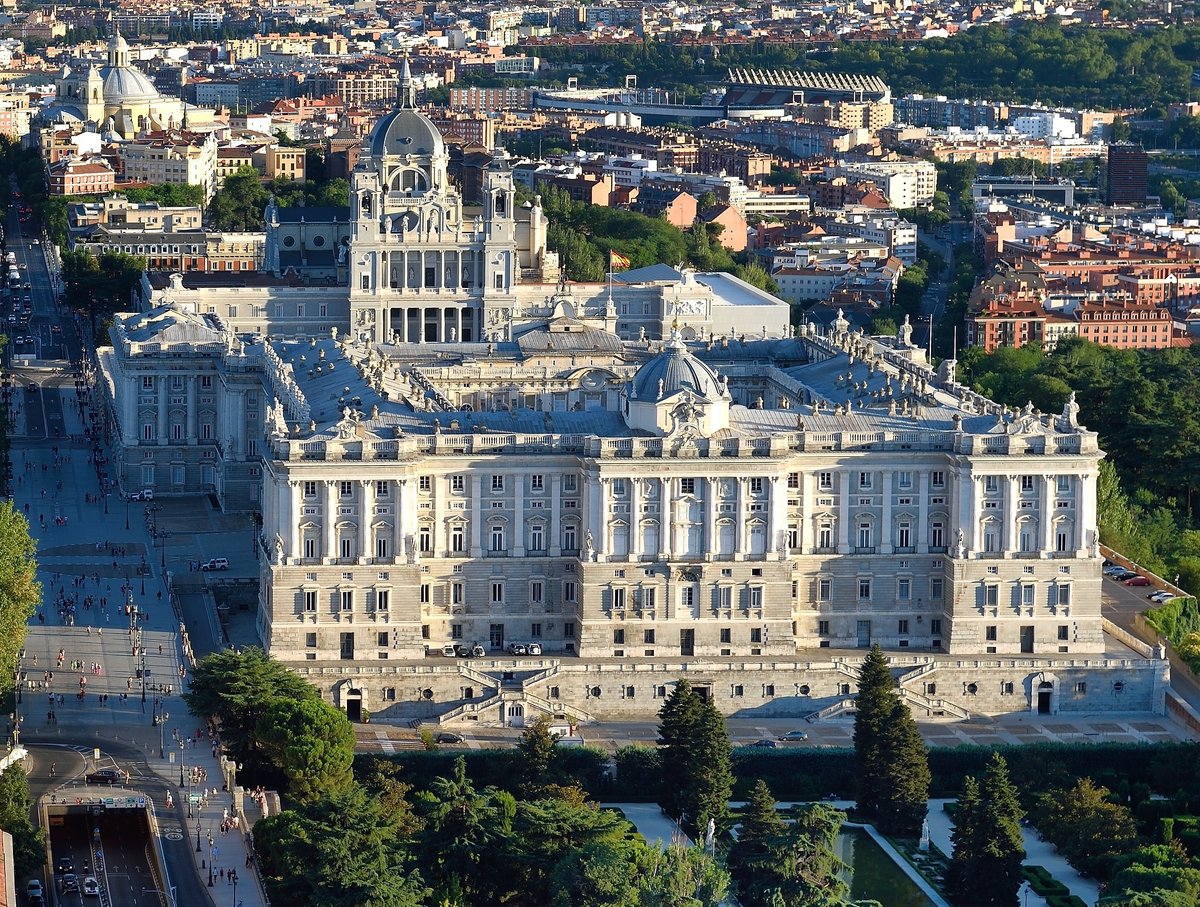

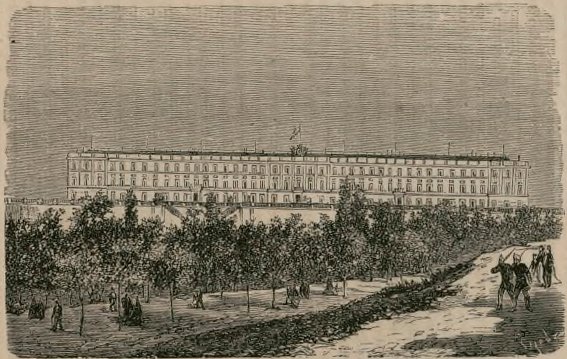
The Royal Palace of Madrid, situated in Plaza de la Armería, is the official residence of the Spanish royal family. It is the largest royal palace in Europe, featuring over 135,000 m2 of floor space and 3,418 rooms. The site has a long history, originally home to a 9th-century fortress built by Muhammad I, the Umayyad Emir of Cordoba, between 860 and 880. After the Moors were driven out of Toledo, the castle retained its defensive function, with Henry III of Castile adding several towers and his son John II later using it as a royal residence.
During the late Middle Ages, the site housed the Alcázar of Madrid, which served as a residence for the Trastámara monarchs. By the 16th century, the Alcázar had undergone substantial expansion. However, on Christmas Eve 1734, a fire originated in the rooms of the French painter Jean Ranc. Response was delayed because warning bells were confused with the call to mass, and the doors remained closed for fear of looting. The fire lasted four days, completely destroying the old alcázar and causing the loss of some works of art, including Diego Velázquez's Expulsion of the Moors.
A new, larger palace was built from scratch on the same site for the Bourbon dynasty. Construction began in 1738 and followed a design by Filippo Juvarra and Giovanni Battista Marchetti, with contributions from several other architects. Philip V of Bourbon had already begun renovating the royal apartments in 1700 to move away from the austere style of the Habsburgs. The new palace was completed between 1738 and 1755, with Charles III first occupying the building in 1764.
Over the following centuries, the palace underwent further modifications. Francesco Sabatini was called in 1760 to enlarge the building, completing the southeast tower known as la de San Gil. In the 19th century, Ferdinand VII began a thorough renovation to transform the building into a modern French-style palace, while his grandson Alfonso XII later proposed plans to give it a Victorian-style residence.
Sources: Wikipedia, OpenStreetMap, Wikidata, Wikimedia Commons
Written by Nik Frost
Discuss this with the author and others
No comments yet. Be the first to start the conversation.