
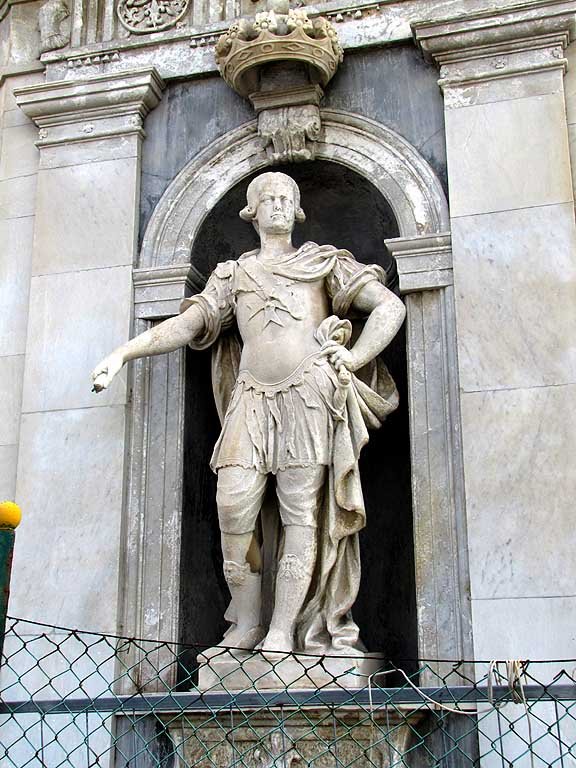
Completed in 1626, the Monument of the Four Moors in Livorno, Italy, commemorates the victories of Ferdinand I of Tuscany over the Ottomans. Created by Pietro Tacca, the monument features four bronze statues of enslaved prisoners chained at the base of an earlier work consisting of the statue of Ferdinando I and its monumental pedestal.
Three of the statues represent people of the southern Mediterranean coast while the fourth statue has characteristics of a black African. The four Moors symbolize the four corners of the world. Although the four chained prisoners are meant to represent the victories of Ferdinando I over the Ottomans, some scholars have posited different interpretations due to the presence of the statue with the black African characteristics.
This design influenced sculptural design for several decades. It is thought that Tacca's work may have been influenced by three columns in the shape of African men in Carrara, and the monument itself influenced works such as Bernini's Fountain of the Four Rivers and a fountain in Marino.
Sources: Wikipedia, OpenStreetMap, Wikidata, Wikimedia Commons
Written by Nicolo Ciampini
Discuss this with the author and others
No comments yet. Be the first to start the conversation.