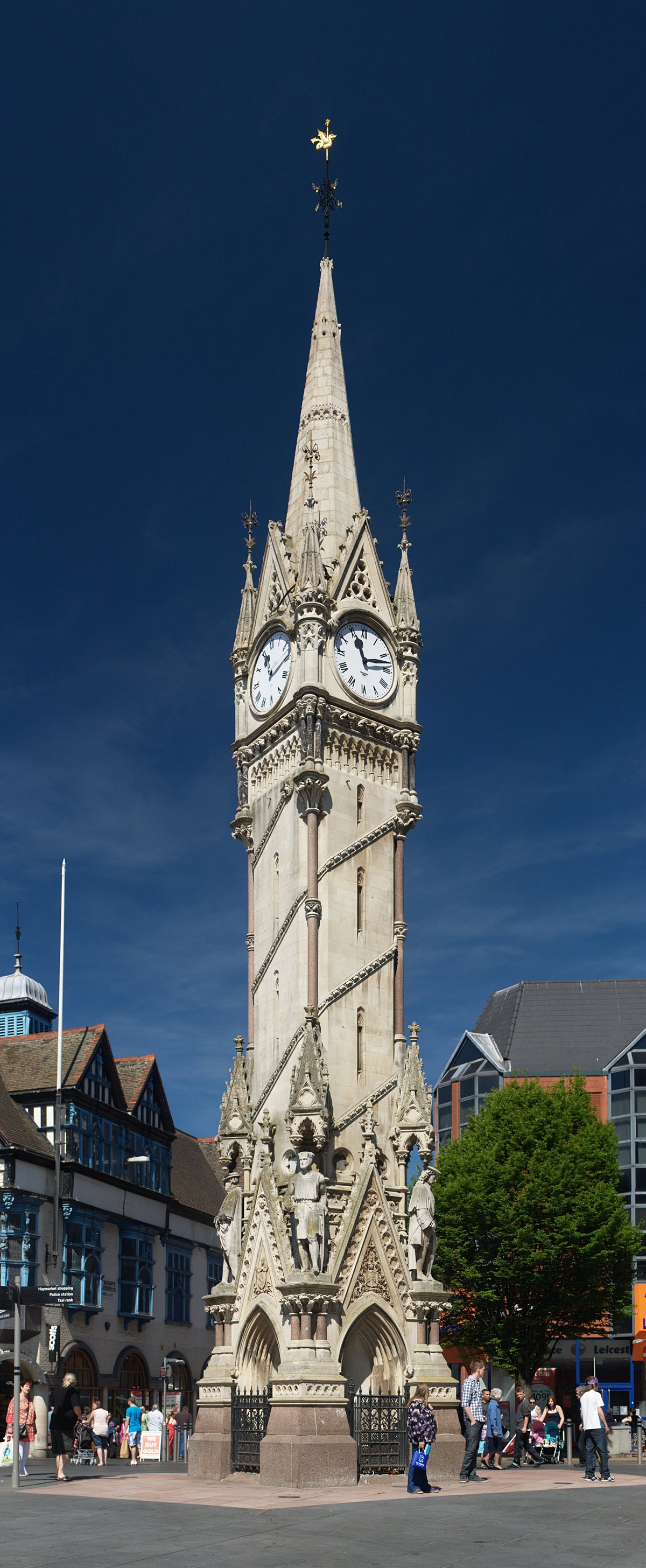
The Haymarket Memorial Clock Tower stands tall in the heart of Leicester, England. For over a century and a half, it has marked time and been a beloved meeting point. The tower was constructed in 1868, but its history dates back to the 1700s. In the 1750s, an Assembly Room building stood on the site, and later, a hay market. By the 1860s, the Assembly Room had been demolished, leaving a wide area that made crossing for pedestrians difficult. To address the issue, a petition was launched in 1867 to erect a clock tower, funded through public contributions.
The design was chosen from 105 submissions. Among the 472 subscribers was John Burton, who ran a photography business adjacent to the site. The balance of the required funds was provided by the Corporation of Leicester. The construction of the Clock Tower began in 1868. Ketton stone, Mountsorrel granite, Peterhead granite, and Portland stone were used in its construction. The clock mechanism was provided by Gillett and Bland of Croydon. The Clock Tower has four statues: Simon de Montfort, Thomas White, William Wyggeston, and Gabriel Newton.
The tower was initially a traffic island, surrounded by a busy intersection. In the first decade of the 20th century, the Clock Tower was converted into the centre-piece of a roundabout, making it one of the first of its kind in the UK. Tram lines were installed in the area between 1903 and 1904. In the 1930s, calls were made to demolish the tower, and in the 1960s, suggestions were made to relocate it to Victoria Park, but the tower remained. Pedestrianization brought changes to the area in the latter half of the 20th century.
Humberstone Gate and Gallowtree Gate were closed to traffic, and the Clock Tower is now bounded only by a road on its northern side. Restoration work was undertaken in 1992 by architects and engineers Pick Everard, as part of their 125th-anniversary celebrations. Leicester City Council unveiled plans to enhance the Clock Tower in the early 21st century. The Clock Tower is a Grade II listed building. In 2010, the clock was repaired due to it running slow.
Sources: Wikipedia, OpenStreetMap, Wikidata, Wikimedia Commons
Written by Nicolo Ciampini
Discuss this with the author and others
No comments yet. Be the first to start the conversation.