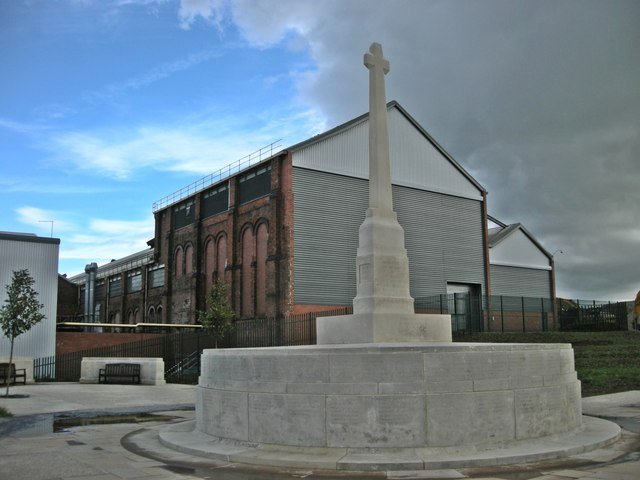

The British Thomson-Houston Company was busy making radio and signalling equipment for the Royal Navy when the Great War broke out. When their own workers left the factory to fight, the company commissioned a war memorial to honour those who were killed in service.
Sir Edwin Lutyens was the man behind the London Cenotaph and the Thiepval Memorial, yet he was also a hired hand for private industry. This is one of six times he was commissioned by a private company to build a war memorial. These projects included memorials for the Midland Railway, North Eastern Railway, Imperial Tobacco, the London Assurance Company, and Lloyd's of London.
Standing 7.3 metres tall, the Portland stone cross sits on a base so wide it is unusual even for Lutyens. It sits on a 7.5-metre diameter plinth. Underneath the base, a time capsule remains buried, holding information about the company and its war records.
You won't find it at the old factory gates anymore. The site was redeveloped in 2010, so the memorial was moved about 400 metres away to Technology Drive. It still carries the names of the 243 men lost in the first war, later updated to include 175 more from the second.
Sources: Wikipedia, OpenStreetMap, Wikidata, Wikimedia Commons


Written by Nicolo Ciampini
Discuss this with the author and others
No comments yet. Be the first to start the conversation.