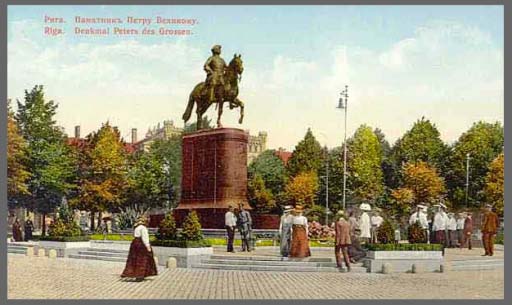

The decision to create a monument to the first Russian emperor was made in 1903. At the same time, a call for donations was issued. The appeal was answered by the broadest segments of the population, as well as city and provincial government bodies, high-ranking officials, and representatives of the Baltic German knighthood. In total, 87,236 rubles and 89 kopecks were collected. Most private donors were Latvians; many donations also came from the Baltic Germans, and, of course, the Russian population of Livonia.
Fifty-eight sculptors participated in the competition (based on the number of projects submitted on a competitive basis to the provincial department). After some deliberation, the commission decided to give preference to the expressive project of Professor Gustav Schmidt-Kassel from the renowned Berlin Academy of Architecture (which was also attended by the founder of national architecture, Janis-Fridrihs Baumanis). His project was based on the stylistic traditions of classicism and, in accordance with the artistic concept of this direction, was adorned with the motto “War and Peace.” Subsequently, the sculptor received an honorary state award for his work — the Order of Saint Stanislaus, second class.
It is also worth noting the other participants in the competition who won the top prizes and were awarded honorary distinctions. The third prize was awarded to sculptor Wilhelm Wandschneider, the author of the Riga statue of Mikhail Bogdanovich Barclay de Tolly. The second prize went to Franz Pritel, also a master from Berlin; in his project, Peter is depicted sitting on a horse, holding an unrolled scroll in his hand, on which the privileges of various local population groups are formulated. The first prize was awarded to Alexander Bauman from Saint Petersburg, who emphasized the verticality of Peter’s figure, presented as riding a horse. Ultimately, it was decided to support the “equestrian” project as more “majestic.”
The equestrian statue of the autocrat-reformer was started in the early months of 1909 and was practically completed within a year, by the time the imperial family arrived in Riga, which was connected with the grand celebration of the bicentennial of Livonia’s incorporation into the Russian Empire.

A special tribune accommodating a thousand spectators was erected for the inauguration guests; the monument was covered with white fabric, which was removed at the most solemn moment, captured by the official photographer of the event, Alexander Stanke.
The celebrations marking the installation of the monument to Emperor Peter the First lasted three days in the provincial center. During his official three-day visit dedicated to the significant anniversary of Livonia’s incorporation into the Empire, Nicholas II inspected a number of Riga’s sights, including, first and foremost, the House of the Blackheads, where he met with representatives of the Baltic Germans.

The imperial family’s visit program also included a visit to Petrovsky Park, located at the mouth of the Agenskalns Bay, where the emperor himself planted several oaks. During the meeting of the emperor with the two main representatives of the provincial administration — the Governor-General of Livonia, Zvyagintsev, and the city mayor, George Armitstead — the tsar distributed many commemorative medals, tokens, and gifts.
In August 1914, during World War I, a decision was made to transport cultural monuments, higher educational institutions, and industrial enterprises. The list of cultural and historical valuables to be evacuated included the monument to Peter the First by Gustav Schmidt-Kassel. In the summer of 1915, the Kaiser’s army was advancing on Riga. Therefore, the monument to Peter the First was removed from its pedestal and loaded onto the evacuation ship “Serbino,” which sailed under the English flag. In 1915, the statue was rolled on rollers to the deck and loaded onto the ship; the hatch had to be opened because the statue did not fit, with part of the monument (specifically, the horse’s hindquarters) sticking out. The “Serbino” sailed to the island of Vormsi (Moonsund Archipelago), where a transshipment base for evacuated valuables was located; the ship was supposed to wait there for the arrival of a guard ship that would escort the “Serbino” through the waters of the Gulf of Finland. However, the military ship did not arrive, and the “Serbino” stood idle near the island for a whole day. During this delay, a Kaiser’s destroyer passing through the Moonsund Archipelago decided to bomb the “Serbino,” as a result of which the cargo ship with its valuable cargo in the hold sank to the bottom, where it was destined to lie for more than fifteen years. The crew of the sunken ship was evacuated to shore. The ship’s captain stayed at a “small Petersburg hotel,” where he met with an acquaintance who witnessed the evacuation of the monument. The captain reported that the statue, protruding from the hatch, was thrown out of the hold at full speed due to strong internal pressure (the ship was sinking, and the pressure inside the hold increased according to the laws of physics proportional to the increasing depth). The captain allegedly said that the statue did not go to the bottom along with the “Serbino.” The article’s author wrote that about a week after this meeting, the captain and his crew died on another voyage, and the author remained the only eyewitness.
On July 11, 1928, the Riga City Council decided to demolish the empty pedestal as unnecessary. The pedestal is still visible in a photograph from October 1931, covered with election posters, but it was already gone in a photo of a November 1931 rally.
At the same time, preparations were underway for the construction of Latvia’s main monument — the Freedom Monument (architect Ernest Shtalberg, sculptor Karlis Zale) practically in the same place (just a little higher along the direction from the City Canal).
Ten cubic meters of granite from the monument’s pedestal were used by Ernest Shtalberg in 1937 to build the monument to the defenders of Riga (Sudraba Kalnins) in Imanta.
In 1934, news arrived in Riga that a professional diver from Estonia, Anton Nigola, had raised the ship “Serbino” from the seabed, as well as the equestrian statue of Peter, exactly thirty meters from the ship sunk during World War I. All details were found except for both ears of the horse.
The Estonian Society for Raising Ships offered the Latvian side to buy the found monument. The proposal aroused great interest among the city council members and prompted a series of meetings almost entirely devoted to this topic. The Estonian side requested 15,000 Estonian kroons (according to the Bank of Estonia, in 2021 this amount corresponded to 75-90 thousand euros). On July 10, 1934, at a meeting of the Riga City Council chaired by Mayor Hugo Celmins, a decision was made to purchase the remains of the monument on the condition that the monument was in good condition, and the payment would be made in lats by mutual agreement and according to the exchange rate established on the stock exchange. The decisive vote at the meeting was largely held by Latvian engineer-architect Pavils Dreimanis (one of the authors of the Riga Central Market). On July 23, 1934, the monument returned to Riga, albeit in disassembled form. There was no other way to handle the statue — the Estonian divers did not have a winch with a lifting capacity of three tons. They placed some explosives under the horse’s belly, thereby breaking the monument. The horse’s belly was literally torn off, the riveted parts were destroyed, and the monument fell apart into pieces.

While a suitable place was being sought for the monument, the first temporary shelter was the archway of the Riga Castle. The Department of Monuments, together with the chief city architect, had already eyed Viesturs Garden, whose origin is connected with Peter the First. Later, parts of the monument were moved to the cross gallery of the Dome Cathedral, where they were laid for an indefinite period. During World War II, no one paid attention to the ruins until 1959.
During the Soviet period, the monument changed location for the third time — it was moved to the warehouse of the Riga Improvement Department. Only in the early 1970s did the idea of restoring the monument return, thanks to the well-known Latvian local historian, historian, and publicist Georgy Vasilyevich Nikitin.

As a result, largely thanks to Nikitin’s archival and journalistic research, the Riga City Executive Committee made a decision dated September 25, 1977. At this meeting, the city executive committee agreed to restore the monument, but only by 1990.
For a long time, the monument was forgotten; only a few enthusiasts and rare professional local historians knew and remembered it. In the late 1980s and early 1990s, there was a threat of melting the monument down for non-ferrous metal. However, former Soviet officer Stanislav Razumovsky, together with a group of like-minded people, took the monument from the semi-abandoned warehouse and transported it to the territory of the Soviet military unit on Abrenes Street. At the end of 1989, Razumovsky personally cast one of the missing parts of the monument and, together with friends, almost completely assembled the monument. With the arrival of the Latvian military unit, Janis Skrodelis, its commander, took over the honorable task of restoring and protecting the monument. Soon the monument came into the possession of entrepreneur Evgeny Gomberg, who became interested in the controversial fate of the equestrian statue. It was he who financed the comprehensive restoration of the Riga bronze rider. Later, the head of Peter, which Stanislav Razumovsky carefully kept at home, was attached to the monument; eventually, it was deemed best to transfer it to the Russian Embassy in Latvia.
In 2001, the Riga City Council decided to gift the monument to the city of Saint Petersburg. Saint Petersburg was ready to accept the monument, but through the efforts of the Russian Embassy, this “gift” was stopped. By agreement with the Saint Petersburg city administration, in connection with the visit of their delegation to the celebration of Riga’s 800th anniversary on August 17, 2001, the monument was displayed for viewing in Kronvalda Park on the bank of the Riga Canal.
On the first day, some radicals threw several eggs at the back of Peter’s statue. After three “trial” days, the patron Evgeny Gomberg was fined 25 lats by decision of the Riga City Council (Mayor Gundars Bojars), accusing him of unauthorized actions in an administrative manner. Gomberg continued to fight for the installation of the monument for some time, but his attempts were unsuccessful.

Three days later, at the request of national deputies of the Council, Evgeny Gomberg took the monument to the parking lot of his company Teikas Nami, where it remained in storage for the next nineteen years. Throughout all these years, the monument remained the property of the Riga City Council.

In 2003, in connection with the celebration of the 300th anniversary of Saint Petersburg, a copy of the monument was cast from plaster molds taken by Denis Gochiayev from the sculpture specifically for this purpose. Today, this copy is installed in the Konstantinovsky Palace in the suburb of Saint Petersburg, Strelna.

In 2020, Evgeny Gomberg, with the agreement of the Riga and Jūrmala City Councils, moved the monument to Peter I to the territory near his mansion in Jūrmala, where it is well accessible for viewing. In June 2023, an exchange agreement was concluded, under which the sculpture became the private property of E. Gomberg’s family, and in return, the Council received ownership of two monuments already installed in Riga — the bust of George Armitstead and the monument to Filippo Paulucci, which previously remained the property of the Gomberg family.
https://ru.wikipedia.org/wiki/Monument_to_Peter_I_(Riga)
https://eadaily.com/ru/news/2020/08/03/bronze-peter-i-appeared-in-jurmala-who-was-exiled-from-riga


Written by Jermaine
Discuss this with the author and others
No comments yet. Be the first to start the conversation.