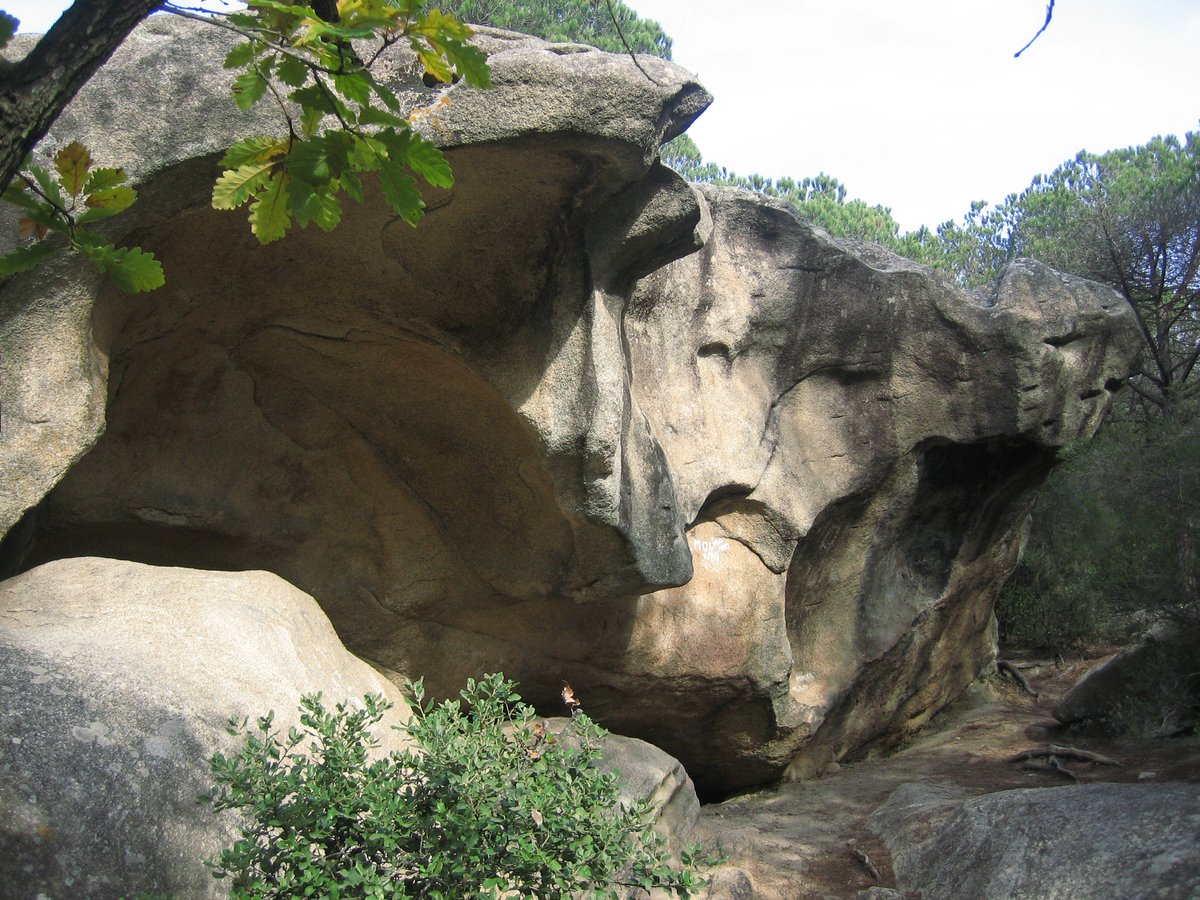

Nestled within the Parc de la Serralada Litoral, La Roca del Vallès, Catalonia, stands the La Pedra de les Orenetes, a Patrimoni de la Humanitat. This site is a large granite block of about 8 m wide, 3 m long, and 3 m high, forming a small shelter and adjacent cavities. The rock surface is marked by many alveoli and erosion cracks. While its exact use is uncertain, it may have been a ritual center or a meeting place.
In 1946, Josep Estrada i Garriga discovered thirty-two rock paintings of Llevantí or schematic style. These paintings represent very diverse motifs: human and anthropomorphic figures, quadrupeds, two cervids, and a hare with strokes of difficult interpretation. While precise dating is difficult, scholars place the anthropomorphic figures between the Mesolithic and Neolithic, and the rest towards the Final Neolithic and the Bronze Age. These likely date to the same period as the construction of the nearby megaliths.
These are the only rock paintings on granite in Catalonia and were extensively documented between 1987 and 1989 during the Corpus de Pintures Rupestres de Catalunya project. The site was declared Patrimoni de la Humanitat as part of the Art Rupestre de l'Arc Mediterrani de la península Ibèrica. It also holds the status of Bé cultural d'interès nacional.
La Pedra de les Orenetes can be reached on foot from km 23 of the carretera de Sant Adrià del Besòs to La Roca del Vallès. After parking at the Les Roquetes urbanization, visitors can follow the carrer de la Ruta Prehistòrica to the highest part of the hill. A narrow street leads to a path that ends at the rock, where there is approximately 1 km from the beginning of the path to the urbanization.
Sources: Wikipedia, OpenStreetMap, Wikidata, Wikimedia Commons
Written by Nicolo Ciampini
Discuss this with the author and others
No comments yet. Be the first to start the conversation.