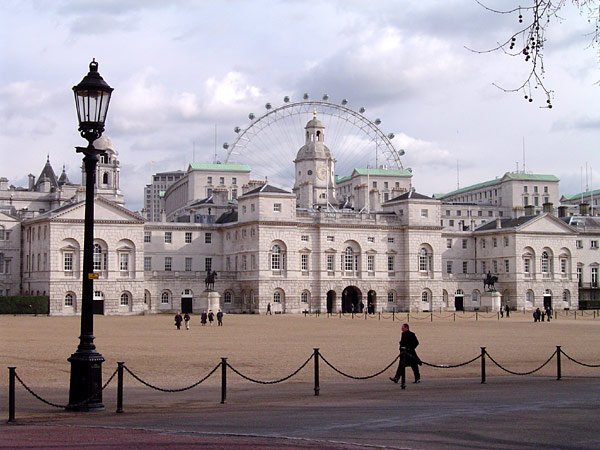

Why does an elegant Palladian design have to wear such a chunky Baroque clock tower? When architect William Kent died in 1748 before the old Horse Guards were demolished, his decision to retain the clock tower resulted in a peculiar blend of styles. It is no wonder Charles Knight described it as "the ugliest building in the metropolis". This building, completed in 1759, stands as a prominent part of the skyline between Whitehall and St James's Park.
Did you know this place started as stables and barracks for the Household Cavalry? It eventually transformed into the main military headquarters for the British Empire, serving as the offices for the Commander-in-Chief of the Forces and the Secretary at War. For many decades, the term 'Horse Guards' was used as a metonym for British Army headquarters. It remains a gateway between Whitehall and St James's Park, and it is still ceremonially defended by the King's Life Guard.
In 1858, Queen Victoria had to personally order Prince George, Duke of Cambridge, to vacate the building because he was so reluctant to move to the new War Office at Cumberland House. Even now, the royal family watches the annual Trooping the Colour ceremony from the windows of the office once occupied by the Duke of Wellington. That office, originally intended for courts-martial, was where Wellington's coffin rested on the night before his state funeral in 1852.
You can still wander through the archway between Whitehall and St James's Park. While the military still holds its ground, part of the building houses the Household Cavalry Museum which is open to the public. You can also see the preserved desk of the Duke of Wellington in the same room that once served as the headquarters for the London District and the Household Cavalry.
Sources: Wikipedia, OpenStreetMap, Wikidata, Wikimedia Commons
Written by Nicolo Ciampini
Discuss this with the author and others
No comments yet. Be the first to start the conversation.