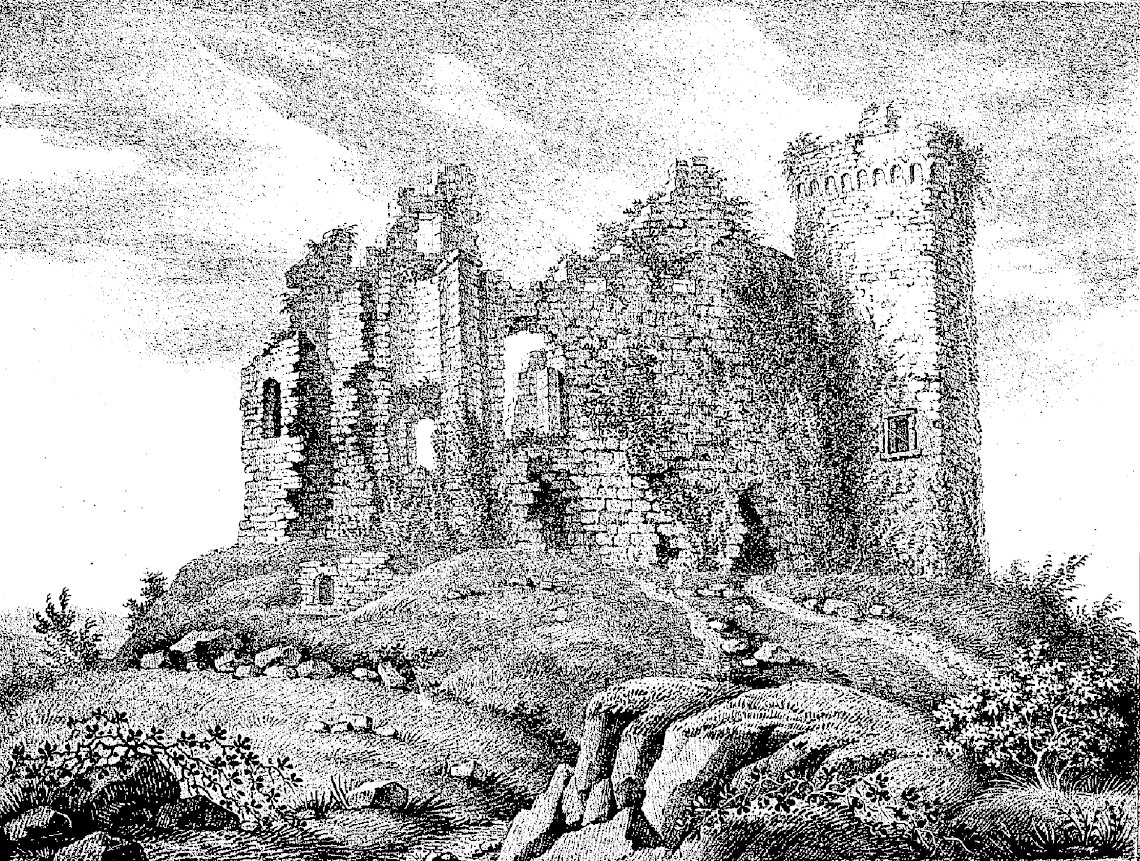
Situated in the Normandy region of France, the ruins of La Haye-du-Puits offer a fascinating glimpse into the lives of a series of powerful baronial lords who controlled the area over a period of several centuries. The castle, which was first built in the 11th and 12th centuries, served as the seat of an important Norman baronnie, seeing ownership transfer through a number of hands over the centuries as it passed through the ranks of various Norman noble families.
The first recorded owner of the castle was Richard Turstin Haldup, a baron de La Haye-du-Puits and possibly the founder of the abbey of Blanchelande in 1154. However, the exact origins of the castle are unclear, with some sources suggesting it was founded by Haldup himself, while others claim it was founded by his contemporary, Raoul.
In the mid-12th century, control of the castle and its surrounding lands passed to Robert de La Haye, whose family would remain in control of the region for several generations. Robert de La Haye was seneschal of Henry I of England, and Richard de La Haye, his son, was connétable of Normandy and seneschal of the King of England Henry II.
In the 16th century, the castle was purchased by the de Cerisay family, who later renovated it in a Renaissance style. In the 17th century, it passed to the de Motteville family, who owned it until the French Revolution.
Today, the remnants of the castle and its surrounding area are classified as a historical monument. The quadrangular tower-gate, which still stands today, offers a tantalizing glimpse into the castle's grandeur during its heyday, and the surrounding land serves as a reminder of the area's rich and complex history.
Heritage level: 2
Ruins: yes
Wikidata description: Le château de La Haye-du-Puits est un château des XIe et XIIe siècles. Il est situé sur une motte de trois mètres de haut sur le territoire de l'ancienne commune française de La Haye-du-Puits, dans le département de la Manche, en région Normandie. Il est à l'entrée nord du bourg de La Haye-du-Puits.
Sources: Wikipedia, OpenStreetMap, Wikidata, Wikimedia Commons
Written by Nicolo Ciampini
Discuss this with the author and others
No comments yet. Be the first to start the conversation.