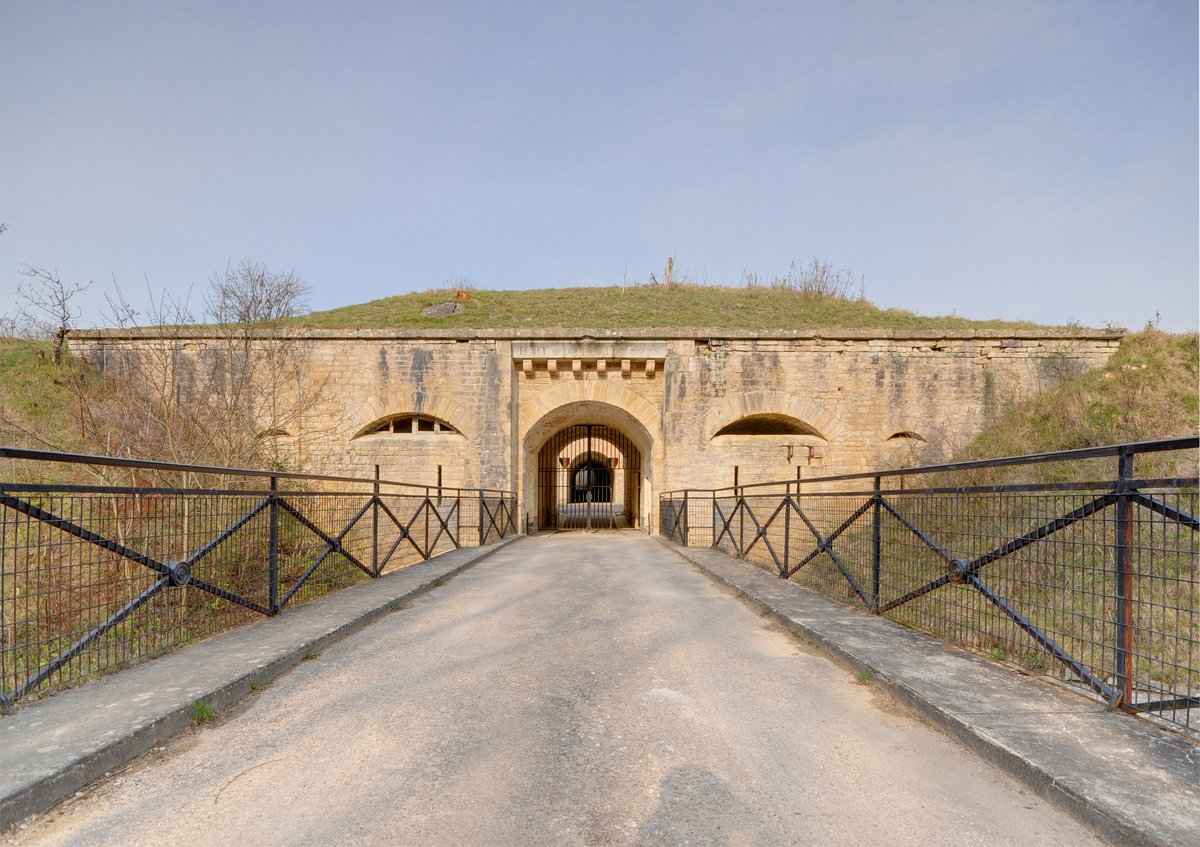

Constructed between 1875 and 1876, the Fort de la Motte-Giron stands on a plateau near the western end of Dijon. The fort was built to protect the city against potential threats, and its irregular pentagonal moats covered an area of 4.2 hectares. Its defenses were secured by three simple caponnières and one double one (northwest).
The fort was originally named Fort de la Motte-Giron, but was subsequently renamed Fort Roussin in 1887, in honor of Albin Roussin, a naval officer and politician from Dijon. However, this name change was reversed in 1887. In 1901, the fort was placed in the third category, with reduced garrison and armament. During World War I, the fort was used as a training center and later as a prisoner-of-war camp for German officers. Between 1940 and 1944, it was used as a prison for French civilians, some of whom were later deported.
From 1944 to 1948, it was used as a transit center for German prisoners of war. From 1948 to 1954, it was used as a transmission center for the French Air Force. In 2002, the city of Dijon purchased the fort, beginning small-scale restorations. In 2006, the fort was inscribed as a historical monument by the prefecture. As of now, the fort is still owned by the city of Dijon. Sheep from the Sologne region graze in the moats.
Sources: Wikipedia, OpenStreetMap, Wikidata, Wikimedia Commons
Written by Nicolo Ciampini
Discuss this with the author and others
No comments yet. Be the first to start the conversation.