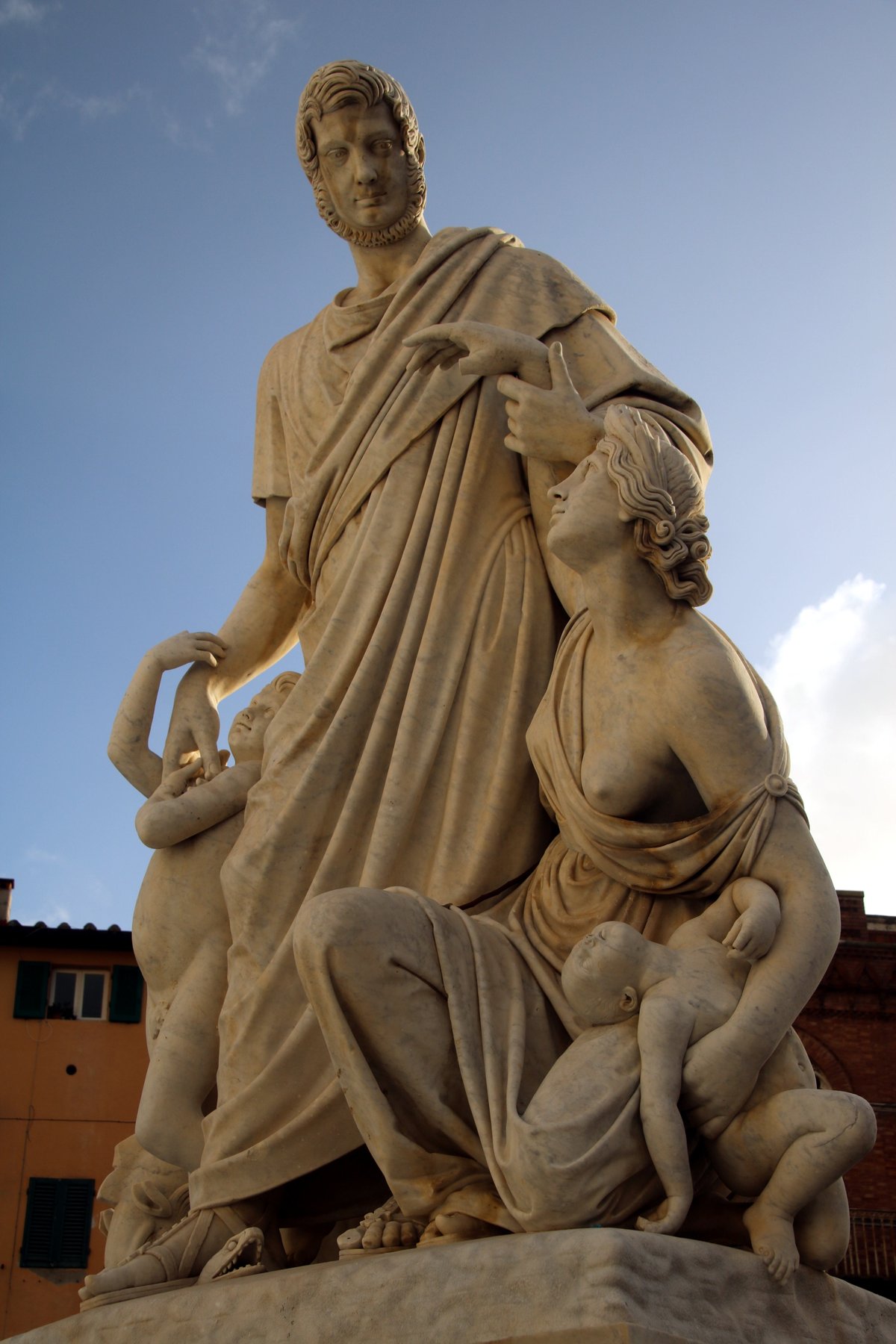

The Monumento a Canapone stands in the center of Piazza Dante in Grosseto, Italy. Crafted from Seravezza-white marble by the sculptor Luigi Magi, the statue honors Leopold II, the Grand Duke of Tuscany. The people of Grosseto affectionately call him Canapone, a nickname referencing his light-colored hair - a color associated with coarse flax.
Leopold II is remembered for initiating significant reforms in the Maremma region during the 19th century. His efforts focused on land reclamation, infrastructure development, and public health, specifically to combat malaria and improve local living conditions. In May 1846, the city held a large celebration to express gratitude for these efforts, featuring horse races, fireworks, and hot air balloon ascents. To mark the occasion, a pamphlet was published depicting the personified Maremma narrating its past and present events.
The sculpture presents an allegory of the Maremma's transformation. At the center, Leopold II is dressed as an ancient Roman, standing with a calm and dignified expression. To his left, he supports a seated woman holding a dying child, representing the generations lost to malaria. In his right hand, he holds a joyful, nude child representing future generations whose survival was secured by his reforms.
The child in his hand crushes a snake beneath his feet, symbolizing the eradication of malaria. A griffin, the emblem of Grosseto, also attacks the snake, representing the joint effort of the ruler and the community to overcome disease and promote progress. The high pedestal bears an inscription thanking the Grand Duke for his immortal benefaction to the regenerated province.
Sources: Wikipedia, OpenStreetMap, Wikidata, Wikimedia Commons
Written by Nicolo Ciampini
Discuss this with the author and others
No comments yet. Be the first to start the conversation.