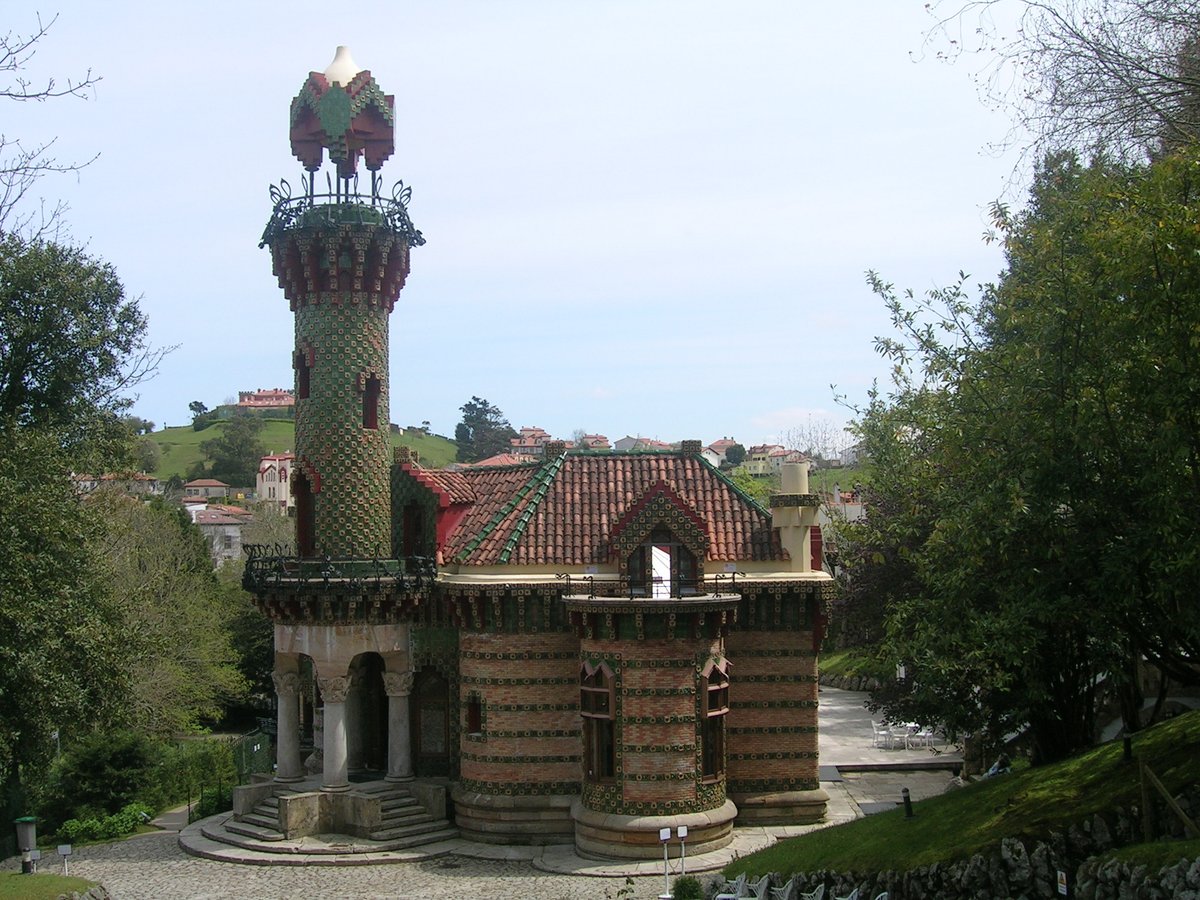

Ever wondered what happens when a wealthy man dies before his dream house is ready? Máximo Díaz de Quijano passed away in 1884, a year before Antoni Gaudí finished El Capricho. It was supposed to be his private summer escape in the countryside, but instead, it became a revolving door for the politically powerful and, eventually, a decaying ruin.
It is a fascinating look at Gaudí's early, orientalist period. He even designed a tower that has been compared to a minaret. It is draped in ceramic tiles that alternate between bright yellow sunflowers and green subtle leaves, supported by four classical columns at the base. If you look closely, you can see his habit of mixing styles - Gothic pointed arches are used to frame the windows of the house.
The house is structured by material: large stone bricks for the basement, smaller red bricks for the main floor, and a sloped roof with ceramic tiles for the attic area. It is rather small but holds many functions and has many different rooms to fit the needs of the patron. Gaudí used many large windows to allow for the use of more natural lighting inside.
After the Spanish Civil War, it fell into disrepair despite being declared a National Monument in 1969. It wasn't until 1988 that it was restored and turned into a restaurant, before finally becoming a museum in 2009. You can visit it today in the Barrio de Sobrellano.
Sources: Wikipedia, OpenStreetMap, Wikidata, Wikimedia Commons
Written by Nicolo Ciampini
Discuss this with the author and others
No comments yet. Be the first to start the conversation.