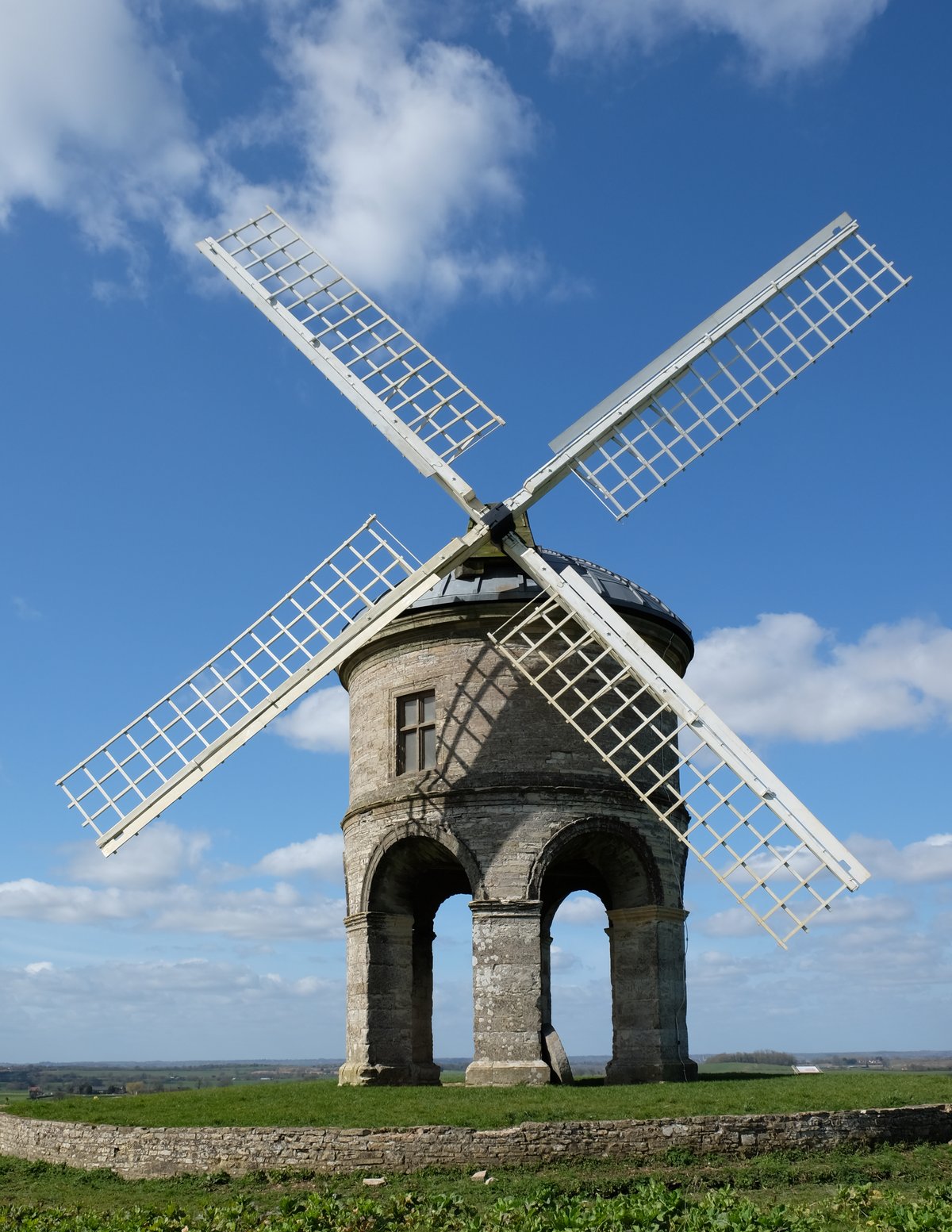

The Chesterton Windmill is a 17th-century cylindric stone tower windmill located outside the village of Chesterton in Warwickshire. Built around 1632–1633, probably by Sir Edward Peyto, the mathematician and astrologer, it is a Grade I listed building and a striking landmark. The mill is unique worldwide in structure and mechanics, featuring a tower supported on six semicircular arches. It is the earliest tower mill in England to retain any of its working parts, with estate accounts showing it has always been a windmill.
The mill's design includes a sandstone string course, four windows in the tower, and a three-light window set in the roof marked "E. P. 1632". Inside, the space between the arches was used to store grain until 1930. The machinery includes a great spur wheel, hurst frame, and a windshaft installed within the cap. The cap, a shallow dome now covered with aluminium, is rotated by a system of rollers in a track plate. Its lattice-type sails have a 60-foot span and rotate counter-clock-wise when seen from outside the mill.
A stone tower similar to Chesterton Windmill exists in Newport, Rhode Island. The commonly accepted theory is that it was built by Benedict Arnold around 1676 after a previous wooden mill was blown down in 1675. Arnold emigrated to Rhode Island in 1635 and became governor in 1663. While the Newport Tower is not quite the same as Chesterton Windmill, it features eight round pillars instead of six arches. Documentary evidence for the Tower's use as a mill in Arnold's will has led to the generally accepted theory that the Newport Tower was based on Chesterton Windmill.
Sources: Wikipedia, OpenStreetMap, Wikidata, Wikimedia Commons
Written by Nicolo Ciampini
Discuss this with the author and others
No comments yet. Be the first to start the conversation.