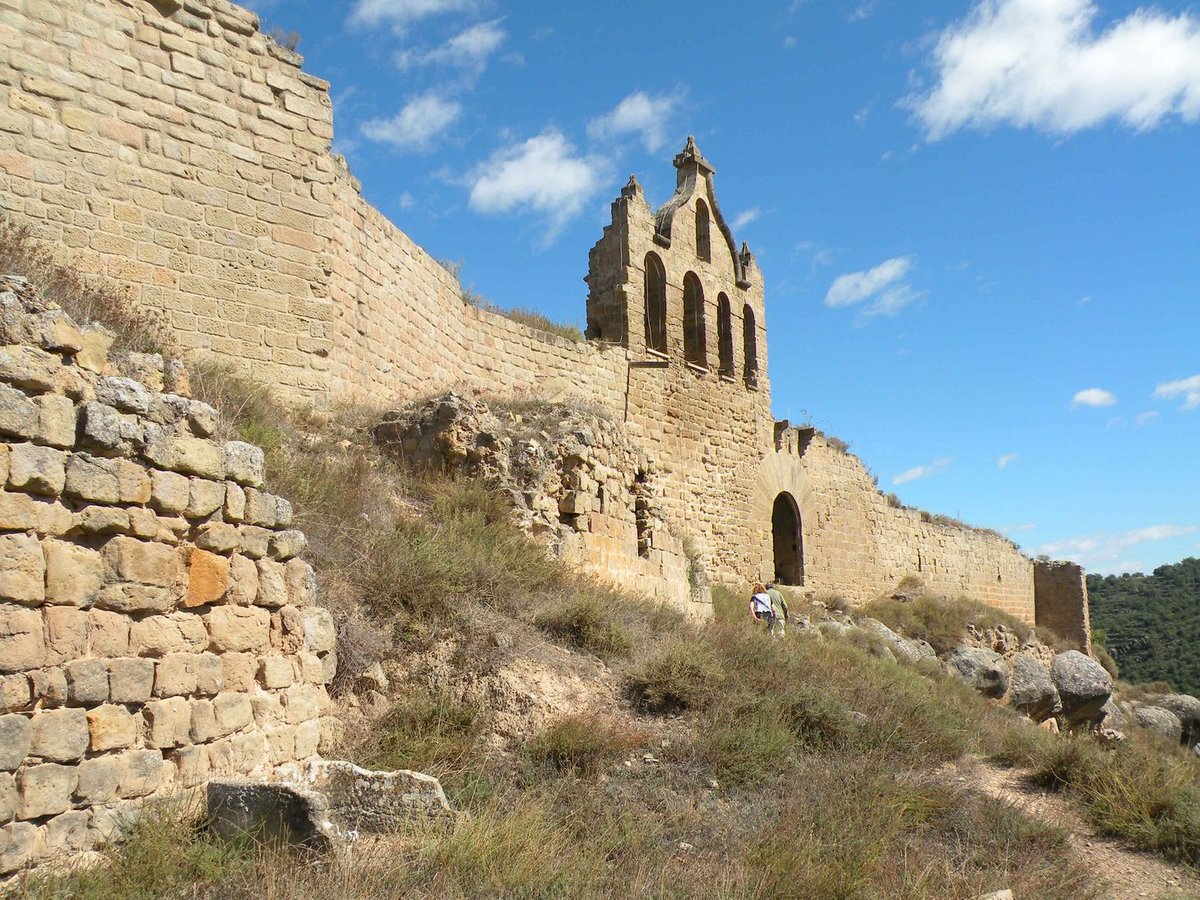

The Castle of Sanaüja, protected as a Bé Cultural d'Interès Nacional, stands tall on a hill over the town of Sanaüja in Segarra. Its history dates back to the 11th century when it was built for defensive purposes by the Count of Urgell. In 951, the Count captured the castle from Muslims, marking the start of its history. The castle was documented in a bulla of Pope Silvestre II in 1001, which granted the fortress to the Bishop of Urgell. Pope Benet VIII confirmed the possession in another writing in 1012. The lands around the castle were organized in the 11th century, and it played a key strategic role in the defense of the valley of Llobregós established by the Count Ermengol II of Urgell in 1035.
Over time, the castle changed hands, including the Bishop of Urgell, Guillem de Cerdanya, who granted it to the Church of Solsona in 1072. In 1099, the castle was again confirmed to the Church of Urgell by Pope Urbà II. A division of duties was agreed between Pere Ramon de Sanaüja and his feudatary Pere Ponç, and also between Pere Ramon de Sanaüja and the Bishop Ot d'Urgell in 1106.
The castle was reaffirmed in 1197, following an agreement between the Countess of Urgell Elvira and Pere de Sanaüja. In the census of 1381, Sanaüja had 104 hearths. The castle was the property of the Mitra urgellenca which ended with the Desamortització of 1836. What remains today is a mix of the original castle, built for defense, and later additions that turned it into a castell palau or bishop's palace.
Sources: Wikipedia, OpenStreetMap, Wikidata, Wikimedia Commons
Written by Nik Frost
Discuss this with the author and others
No comments yet. Be the first to start the conversation.