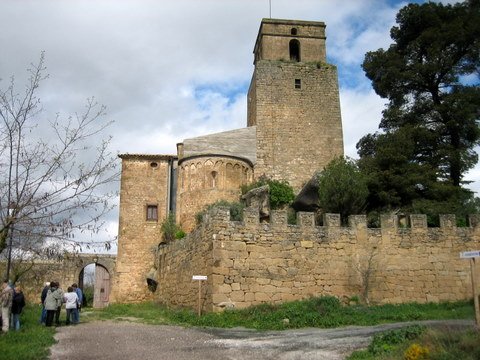

Castell de Ribelles, a medieval castle located in the municipality of Vilanova de l’Aguda, Catalonia, Spain, is a fascinating piece of medieval architecture that has been standing strong for centuries. The castle, initially a vassal of the counts of Cerdanya in the 11th century, has been a witness to significant historical events and changes over the years. [1]
The first written mention of the fortress of Ribelles is dated between 1042 and 1075. Ponç I and Gombau III de Ribelles, descendants of the early Ribelles, participated in the conquest of Lleida in 1149. Gombau III of Ribelles signed as a witness in the charter of Lleida’s population that the counts granted in 1149. He also appeared in 1166 in the act of the foundation of the monastery of Santa Maria de Bellpuig de les Avellanes. [2]
The Ribelles family became more important in the 13th century, with some members participating in the conquest of the Kingdom of Valencia and Sicily. A branch of the Ribelles family settled in Sardinia in the early 15th century. [3]
Between 1404 and 1416, the Santa Clara convent of Balaguer was the lord of Ribelles and appointed bailiffs of the place. Ramon Ponç de Ribelles sold the barony to his second cousin Gispert de Ponts in 1418. The barony was later sold to Francesc de Montserrat, the first marquis of Tamarit in 1671. Castell de Ribelles was awarded a title in 1872 by King Amadeu I, to Josep de Bofarull i Rafart. [4]
Castell de Ribelles is a complex of buildings spanning from the 10th to the 20th centuries. There is a square tower at the complex, with interior walls that have a length of 515 cm. The tower consists of three construction stages. The lower part, up to 9 meters high, was built with large, square-cut stones on the outside. Two loopholes can be observed in the north-east corner of the lower part of the tower. [5]
Sources: Wikipedia, OpenStreetMap, Wikidata, Wikimedia Commons
Written by Nik Frost
Discuss this with the author and others
No comments yet. Be the first to start the conversation.